

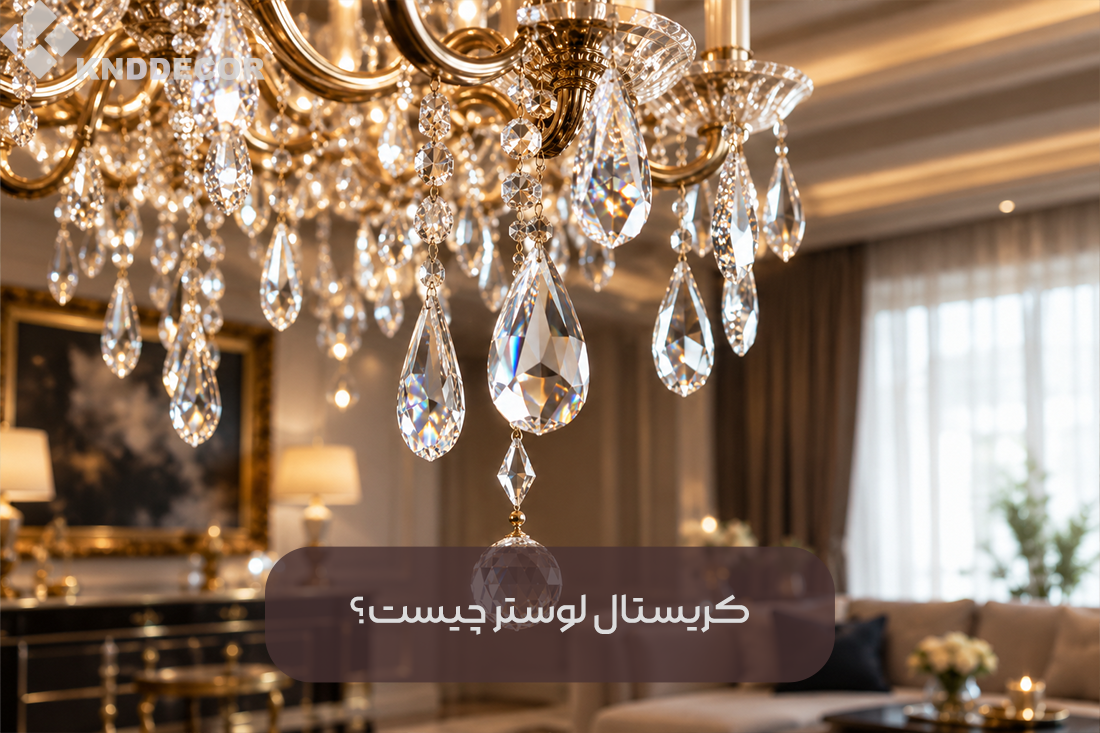
What is Chandelier Crystal? An Overview of Crystal Types, Cuts, and Their Impact on Chandelier Brilliance
-
 نویسنده:
کارشناس فروش
- تاریخ انتشار:
- Reading time: 5 minutes

-
نویسنده:
کارشناس فروش
- تاریخ انتشار:
- Reading time: 5 minutes
When discussing crystal chandeliers, the first thing that usually catches the eye is the brilliance and light reflection within its crystal pieces. However, not all crystals used in chandelier manufacturing are the same in terms of shape, cut, clarity, and how they reflect light.
In fact, a significant portion of a crystal chandelier’s splendor depends on the type of crystal pieces, the form of their cuts, and how they are arranged within the chandelier’s structure.
For this reason, when purchasing a chandelier, it is better not to focus solely on the number of crystals, but also to consider their quality and design.
What exactly is chandelier crystal?
The crystals used in chandeliers are originally made from special types of glass that, depending on their composition and manufacturing process, can have different characteristics in terms of clarity, weight, and light refraction. The type of crystal and how it is cut can affect the degree of brilliance and light reflection.
Consequently, when light passes through the crystal pieces or hits their faceted surfaces, different optical effects are created in the environment.
This characteristic is what has made crystal one of the most popular elements in decorative chandelier design.
Why does the crystal cut matter?
If you look closely at a piece of chandelier crystal, you will notice that its surface is usually not completely smooth but features various cuts and facets.
These cuts cause light to reflect or refract in different directions. As a result, a simple crystal piece can have a very different appearance when the chandelier is turned on compared to when the light is off.
Therefore, the number of crystals is not the only suitable criterion for comparing two chandeliers; the shape, size, and type of the cuts also matter.
Clear crystal or colored crystal?
Clear crystals are the most commonly used in chandeliers because they allow light to pass through and reflect more clearly.
However, some designs also utilize colored, smoked, or specific spectrum crystals. These models are primarily used to create a different decorative effect.
The choice between clear and colored crystal depends on your decoration style. Clear crystals usually create a more classic and formal look, while colored crystals can be suitable for unique and distinctive designs.
How does the crystal shape affect the chandelier's appearance?
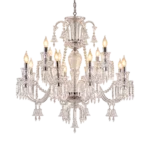
Chandelier crystals can be designed in various shapes, ranging from teardrop and droplet pieces to geometric, elongated, or multifaceted forms.
For example, droplet crystals are typically placed at the bottom of many classic chandeliers, creating elongated vertical lines in their appearance.
In contrast, geometric pieces can create a more modern look.
Therefore, the shape of the crystal should be considered alongside the form of the chandelier body, rather than in isolation.
Does more crystals mean a more beautiful chandelier?
Not necessarily.
Increasing the number of crystals can make the chandelier more detailed, but if the body form, spacing of the pieces, and overall proportion are incorrect, the result will not necessarily be better.
Sometimes, a chandelier with fewer crystals but a precise design creates a much more attractive effect than a model with a large number of decorative pieces.
For this reason, it is better to look at the overall composition when choosing a chandelier.
What role do crystals play in light reflection?
One of the most important features of crystal is its ability to redirect light and create multiple reflections.
When the lamp is turned on, light hits the crystal surface and scatters in various directions depending on its shape and cut. The cleanliness of the crystal surface is also crucial; dust and impurities can reduce surface clarity and diminish the light effect.
This is why a clean crystal chandelier usually has more brilliance than the same chandelier with dust-covered crystals.
Why do some crystal chandeliers have more brilliance?
The final brilliance of a chandelier is not limited to a single factor.
The type of crystal, surface quality, number and shape of cuts, how the crystals are arranged, the type of light source, and even the cleanliness of the components can all affect the result.
Therefore, even if two chandeliers look almost identical from a distance, they may show a significant difference in how they reflect light once turned on.
This is one of the reasons why it is better not to judge a crystal chandelier based solely on its unlit photo.
What is the difference between a crystal chandelier and a glass chandelier?
In the market, the terms “crystal” and “glass” are sometimes used interchangeably, but technically they can refer to different products.
Characteristics such as material composition, refractive index, weight, clarity, and cutting quality can create differences between various products.
Therefore, if crystal quality is important to you, it is best to ask the seller for the product specifications and material type rather than simply settling for the label “crystal.”
What decor style is crystal suitable for?
Crystal is mostly associated with classic and formal decorations, but nowadays, various models with simpler designs are also manufactured.
In classic decoration, crystal can be placed alongside detailed bodies and decorative metals. Conversely, simpler crystal models can also be used in neoclassical spaces.
If your space has a traditional and formal design, reviewing the classic chandeliers KND Decor collection can be useful for comparing models.
For more balanced decorations, you can also look into neoclassical chandeliers .
How do we clean a crystal chandelier?
One of the most important aspects of maintaining a crystal chandelier is cleaning its components correctly.
Before cleaning, the power to the chandelier must be turned off, and the bulbs must be completely cool. It is also advisable to protect the area beneath the chandelier with a cloth or suitable cover to minimize the risk of damage if a piece falls.
For regular cleaning, using a soft, lint-free cloth can be an appropriate option. If a cleaning solution is to be used, it should not be applied without first checking its compatibility with the chandelier’s material and metal finish.
Additionally, it is best not to spray cleaning solutions directly onto electrical components or wiring.
How often should we clean the chandelier crystals?
The frequency of cleaning depends on the location where the chandelier is installed.
A chandelier located in a low-dust area far from the kitchen may require cleaning less frequently. Conversely, a chandelier near the kitchen or in a dustier environment will become dull more quickly. Experts generally recommend light periodic cleaning along with a deeper clean at longer intervals.
The most important criterion is to clean the crystals before a thick layer of dirt builds up.
What should we consider when buying a crystal chandelier?
Before purchasing, it is better not to just look at the overall appearance of the chandelier, but also consider several other factors:
- Clarity and visual quality of the crystals
- Type and shape of the crystal cuts
- How the components are attached to the body
- Build quality of the frame
- Type and number of light sources
- Possibility of replacing the bulbs
- Total weight of the chandelier
- Accessibility of parts for cleaning
- Harmony between the crystal shape and the body design
These factors can be very important for the long-term use of the chandelier.
Summary
Crystal is one of the most important decorative elements in many chandeliers, and its type, shape, and cutting method can significantly impact the final appearance of the light.
The brilliance of a crystal does not depend solely on the number of pieces; surface quality, cut design, how the pieces are positioned, the type of light, and even their cleanliness all play a role in the final result.
Therefore, if you intend to buy a crystal chandelier, it is better to examine the manufacturing quality and their harmony with the overall design of the chandelier, rather than focusing solely on the number of crystals.
A good crystal chandelier should, in addition to its beautiful appearance, be able to reflect light attractively throughout the space when turned on.