

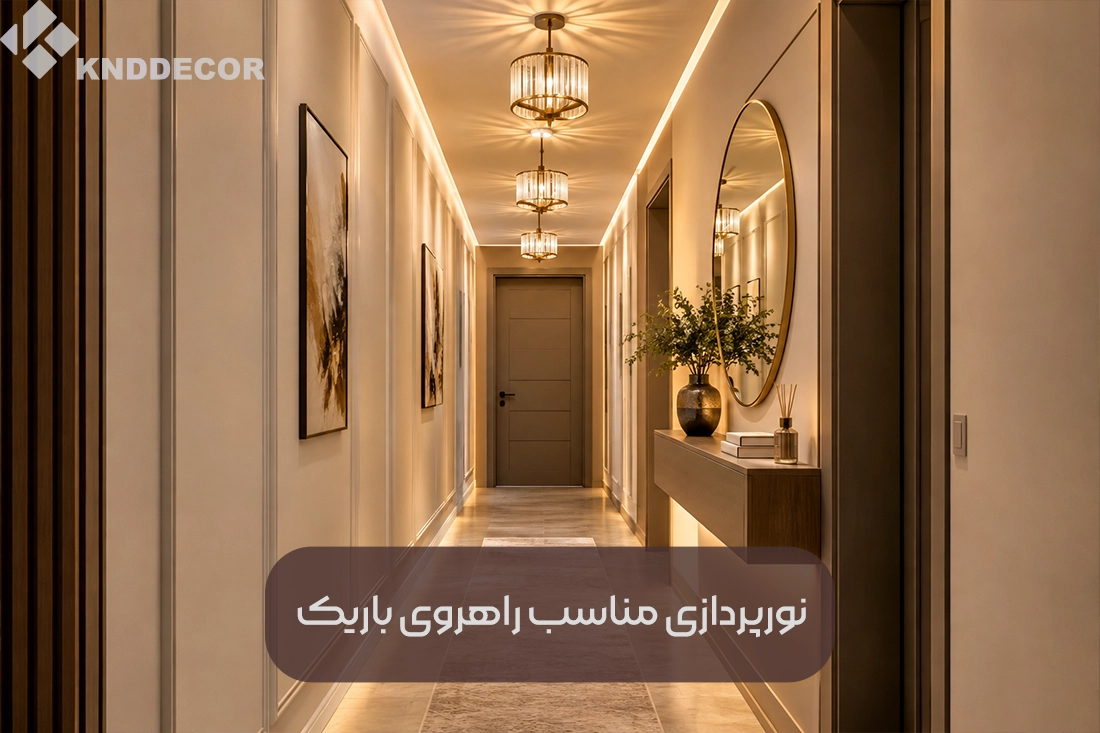
Proper Lighting for Narrow Hallways; A Guide to Making Your Hallway Look Brighter and Larger
-
 نویسنده:
کارشناس فروش
- تاریخ انتشار:
- Reading time: 7 minutes

-
نویسنده:
کارشناس فروش
- تاریخ انتشار:
- Reading time: 7 minutes
A hallway is one of the spaces that is often overlooked in interior design; yet, this narrow section can have a significant impact on the overall feel of a home. A dark and dimly lit hallway can make the space appear smaller, more enclosed, and even cluttered, but proper lighting for narrow hallways can make the same space appear brighter, more spacious, and more attractive.
The main challenge in lighting a narrow hallway is that we usually have limited width, making it impossible to use large chandeliers or bulky decorative elements. Therefore, we must use light sources that provide sufficient illumination without occupying the walking path.
In this article, we will examine what type of lighting is suitable for a narrow hallway, whether a chandelier or recessed ceiling lights are better, the purpose of wall lights, and how to use light to make a hallway appear larger and more beautiful.
Why is lighting for narrow hallways so important?
A hallway usually serves as a connecting link between different parts of the home. People use the hallway to access bedrooms, bathrooms, kitchens, or living areas.
If this path is dark, it not only reduces the aesthetic appeal of the space but also makes using it unpleasant.
Proper lighting can achieve several goals simultaneously:
- Providing sufficient light for movement
- Reducing the feeling of darkness and enclosure
- Making the narrow space appear larger
- Creating harmony with the lighting of other parts of the house
- Highlighting paintings and decorative elements
- Creating a modern and organized look
Therefore, hallway lighting should not be considered just a simple light source; it is an integral part of the home’s interior design.
What is the best type of light for a narrow hallway?
For narrow hallways, a combination of ambient lighting and accent lighting usually yields better results.
Ambient lighting is responsible for illuminating the path, while accent lighting is used to highlight walls, paintings, photo frames, or other decorative elements.
In many hallways, recessed or surface-mounted ceiling lights, linear lights, and low-profile wall sconces are suitable options.
The final choice should be based on ceiling height, hallway width, decoration style, and the amount of natural light.
1. Recessed ceiling lights; a suitable choice for narrow hallways
If your hallway is narrow and you don’t want anything hanging from the ceiling, recessed lights can be a great choice.
These lights do not occupy the vertical space of the hallway and give the ceiling a clean, simple look.
Using several recessed lights along the hallway ensures that light is distributed evenly along the path.
However, you should not increase the number of lights excessively. The goal is to create balanced lighting, not to turn the hallway into a glaring environment.
2. Linear lights for narrow hallways
Linear lights are one of the attractive options for modern spaces.
The elongated form of these lights harmonizes with the shape of a hallway and can emphasize the longitudinal extension of the space.
If the home decoration is modern or minimalist, using a slim linear light on the ceiling can serve as a design element in addition to providing illumination.
In very long hallways, linear lighting can be used to create an organized visual path.
3. Wall Sconces; Functional and Decorative Lighting
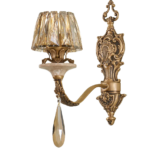
Wall sconces are one of the best options for hallways that have sufficient wall space.
Unlike ceiling lights, wall sconces can play the role of a decorative element in addition to providing light.
For narrow hallways, it is better to choose low-profile models so they do not cause obstruction while passing by.
Placing several wall sconces at regular intervals can also create a visual rhythm along the hallway.
4. Ceiling Lighting with Surface-Mounted Lights
If recessed lighting cannot be installed, surface-mounted lights are a suitable alternative.
Small, low-profile models can be installed along the hallway to prevent the ceiling from looking too cluttered.
For hallways with low ceilings, it is best to use models that do not sit far from the ceiling.
5. Cove Lighting: A Way to Create a More Luxurious Feel
Cove lighting can be very attractive for creating indirect light in a hallway.
For example, cove lighting can be used in false ceilings, along the edges of the ceiling, or even in certain parts of the wall.
The advantage of indirect lighting is that the light source is not directly in the line of sight, creating a softer illumination.
However, cove lighting alone is not always sufficient to fully illuminate a hallway and is best used alongside a general light source.
Is a chandelier suitable for a narrow hallway?
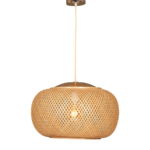
In most narrow hallways, large chandeliers or pendant lights are not a good choice.
A chandelier can be a great option only if the hallway has sufficient width and height, and the selected model has compact dimensions.
If the ceiling is low, a long pendant light can make the hallway space appear smaller and may even create an obstruction in the walking path.
In such cases, recessed ceiling lights, linear lights, or low-profile models are usually more logical choices.
Is warm or cool light better for a hallway?
Choosing the color temperature depends on the home’s style and the purpose of the lighting.
Warm light usually creates a cozier and more relaxing atmosphere and is suitable for homes with classic, neo-classic, or warm decor.
Natural or neutral light can be a great choice for modern spaces, as it shows colors more accurately and creates a sense of cleanliness and brightness.
Very cool light in a residential hallway may make the space look overly clinical and cold. Therefore, it is better to use very cool lights with caution in most homes.
How to make a narrow hallway look larger?
Proper lighting can have a significant impact on the visual perception of a hallway’s dimensions.
Create uniform lighting
If one part of the hallway is very bright and another part is dark, the space will appear more irregular and smaller.
Placing light sources at appropriate intervals can balance the illumination.
Highlight the walls with light
If you have paintings, photo frames, or decorative pieces on the hallway walls, you can draw attention to them using accent lighting.
This method turns the wall from a simple, empty surface into a part of the interior design.
Avoid direct and glaring light
Intense light directly in the eyes is not only annoying but can also reduce the quality of the design.
For hallways, soft and controlled light usually yields better results.
Use light lines
Linear lights or continuous light strips can emphasize the length of the hallway and provide more order to it.
At what distance should lights be installed in a hallway?
The distance between lights should be determined based on the length of the hallway, the brightness of the light, and the ceiling height.
Installing lights at completely irregular intervals usually creates dark and bright spots.
It is better to position the lights so that their illumination covers different sections of the path.
If the hallway is long, it can be divided into several sections, and the lighting for each section should be considered.
If using multiple ceiling lights, it is best that their spacing also appears visually organized.
Hallway lighting with motion sensors
One of the most practical solutions for hallways is the use of motion sensors.
With this method, lights turn on when someone enters the hallway and turn off after a certain period.
For hallways that see high usage during the day, this system can reduce electricity consumption while making space utilization more convenient.
The sensor can be connected to ceiling lights, cove lighting, or smart lighting systems.
Hallway Lighting in Modern Homes
In modern homes, simplicity and clean lines are usually of great importance.
For such a space, the following elements can be combined:
- Linear lighting
- Hidden/Cove lighting
- Recessed lights
- Simple wall moldings
- Accent lighting for paintings
If the wall colors are light, the light can create more reflection, making the hallway appear brighter.
Hallway lighting in classic decoration
In classic decoration, using decorative wall moldings can be an attractive choice.
If the hallway features wall paneling, paintings, or mirrors, lighting can be integrated with these elements.
In such spaces, it is best to coordinate the color of the light fixtures’ bodies with other metallic elements, such as door handles, mirror frames, or furniture details.
Common Mistakes in Narrow Hallway Lighting
Using a single very bright light
A single, very powerful light source in the center of the hallway does not necessarily mean good lighting. It may cause the center of the space to be overly bright while the beginning and end of the path remain dark.
Installing large pendant lights
In narrow hallways, large pendant lights can restrict the passage space.
Choosing very cold light
Excessively cold light can make the home environment feel sterile and impersonal.
Ignoring wall colors
Dark colors absorb more light and may make the hallway feel more enclosed. In these cases, lighting design should be carried out considering the color and texture of the surfaces.
Over-lighting
Using too many lights does not necessarily make the hallway more beautiful. The number of lights should be coordinated with the dimensions of the space and the actual need for illumination.
What type of light should we choose for a narrow hallway with a low ceiling?
If the hallway is both narrow and has a low ceiling, it is best to use fixtures with a very low profile.
Recessed lights, low-profile surface-mounted lights, and linear lighting can be suitable options.
In such conditions, it is better to avoid long pendant chandeliers or bulky lights, as these elements can make the visual height of the ceiling feel even lower.
What lighting is suitable for a narrow and long hallway?
In long hallways, the most important goal is to prevent the creation of dark spots.
You can use several ceiling lights along the path or design a linear lighting system.
If the hallway features paintings or photo frames, accent lighting can also make them look more attractive.
In very long hallways, it is better to divide the lights into several circuits so that the brightness of different sections can be controlled independently.
Can mirrors and lighting make a hallway appear larger?
Yes. Combining mirrors with lighting is one of the effective ways to create a sense of more space.
Placing a mirror on one of the hallway walls and using appropriate lighting around it can cause light reflection and create visual depth.
Of course, the light should not be shone directly onto the mirror surface, as it may create intense and annoying glare.
It is better to place the light in a controlled manner around or on the wall adjacent to the mirror.
What should we measure before choosing hallway lights?
Before purchasing lights or designing the lighting, measure these items:
- Hallway length
- Hallway width
- Ceiling height
- Number of existing doors
- Placement of paintings or mirrors
- Available locations for wiring
- Amount of natural light entering the hallway
It is also better to consider the color of the walls, floor, and ceiling, as the color of surfaces affects the amount of light reflection.
Summary
Proper lighting for narrow hallways is not limited to just choosing a beautiful lamp. To achieve the desired result, harmony must be created between brightness levels, hallway dimensions, ceiling height, decoration style, and the placement of the lights.
In narrow hallways, recessed lights, low-profile surface-mounted lights, linear lighting, and shallow wall sconces are usually suitable options. If the hallway is long, using multiple light sources at appropriate intervals can create more uniform illumination.
Additionally, using accent lighting for paintings, cove lighting for soft illumination, and motion sensors for easier control can enhance the quality of the lighting.
Ultimately, the goal is not to fill the hallway with a large number of lights; the goal is to make a narrow path bright, spacious, safe, and harmonious with the home’s decor by choosing the right light sources.