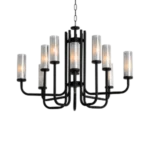
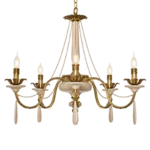
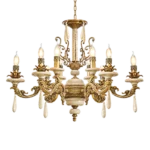
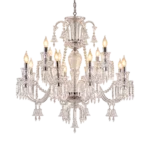


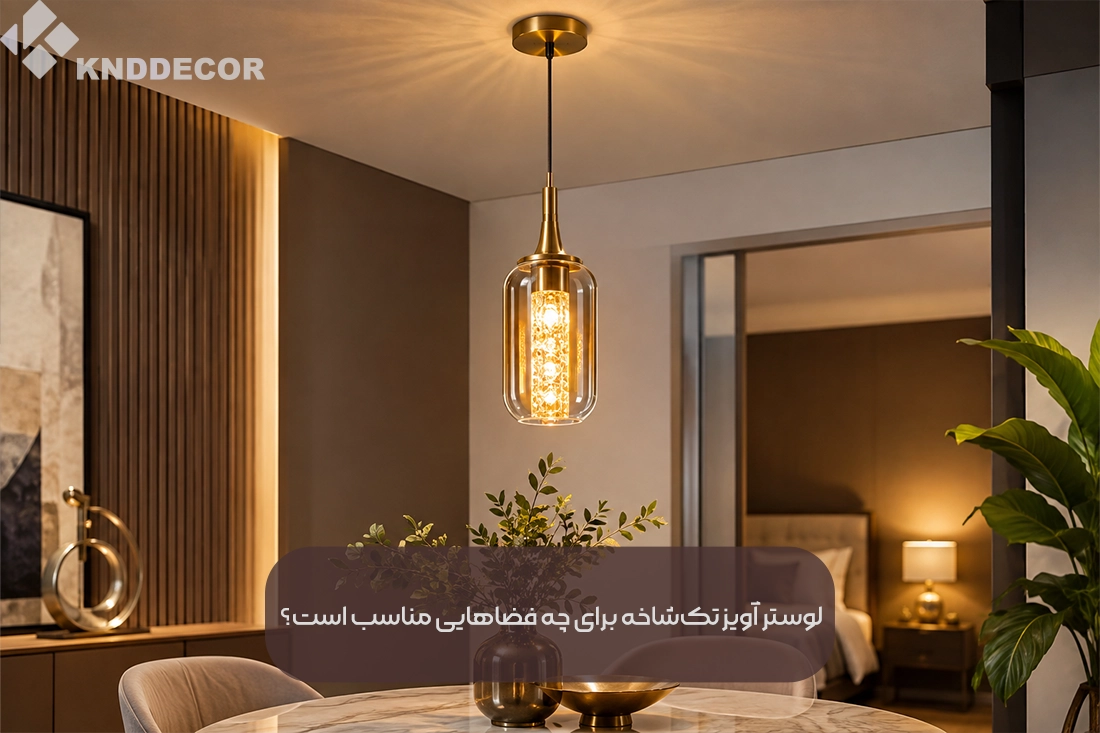
For which spaces is a single-arm pendant chandelier suitable?
-
 نویسنده:
کارشناس فروش
- تاریخ انتشار:
- Reading time: 7 minutes

-
نویسنده:
کارشناس فروش
- تاریخ انتشار:
- Reading time: 7 minutes
Choosing a chandelier is not limited to its appearance alone. The size of the space, ceiling height, layout type, required light intensity, and even furniture dimensions can determine how suitable a chandelier model is for an environment. A single-arm pendant chandelier is one of those models that, despite its simple structure, can provide a chic and functional touch to a space if chosen correctly.
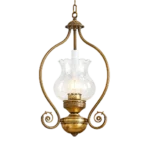
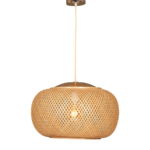
This model usually consists of a single main body or globe that hangs from the ceiling via a wire, chain, or rod. Unlike multi-arm chandeliers, a single-arm design typically creates more focus on a specific point in the space, making it highly practical for localized and decorative lighting.
But which spaces are suitable for a single-arm pendant chandelier? Can it be used in a living room? What about bedrooms or kitchens? And what points should be considered when choosing this model?
In the following sections, we answer these questions.
What is a single-arm pendant chandelier?
A single-arm pendant chandelier is a type of hanging light that typically features one main light source and is attached to the ceiling from a single point. Unlike multi-arm chandeliers, this model concentrates light within a more specific area.
Its simple design allows it to be used in various styles, such as modern, minimalist, industrial, Scandinavian, and even certain classic models.
The most important features of a single-arm pendant chandelier include:
- Simple and compact design
- Ideal for task lighting
- Minimal visual footprint
- Suitable for small spaces
- Wide variety of materials and shapes
- Can be used individually or in groups
- Perfect for creating a focal point in decor
For this reason, this model should not be viewed merely as a small chandelier; rather, it can be used as a tool for creating targeted lighting.
Best spaces for installing a single-arm pendant chandelier
1. Dining Table
One of the best places to use a single-pendant chandelier is above the dining table.
If you have a small or four-person dining table, a single-pendant chandelier can perfectly illuminate the center of the table while providing a simple and neat appearance to the space.
For larger tables, you can place several single-pendant chandeliers next to each other at appropriate intervals. In this case, instead of one large chandelier, multiple smaller light sources are created, giving a modern and unique look to the dining table.
The important point is that the chandelier should be placed almost in the center of the table to ensure balanced light and visual composition.
2. Kitchen Island
Single-pendant chandeliers are also an attractive option for kitchen islands.
If the island is small, even one pendant can be sufficient to create decorative and functional lighting. For longer islands, using two or three single-pendant pendants in a row can yield better results.
In this method, the distance between the pendants should be equal, and their placement should be coordinated with the length of the island.
Using several identical pendants is one of the simple ways to create an organized look in modern kitchens.
3. Bedroom
The bedroom is another space where a single-pendant chandelier can be utilized.
This model can be used in the center of the room, above a small table, or on both sides of the bed.
If you intend to use pendants on both sides of the bed, it is best that their height and model are coordinated with each other. This method, in addition to creating localized light, also creates symmetry in the room’s decoration.
For bedrooms, models with soft light and simple designs are usually more suitable choices; because intense and direct light may not harmonize with the relaxing atmosphere of the room.
4. Home Entrance
The entrance area of a home usually needs focused and decorative lighting, and a single-pendant chandelier can perform well in this section.
If the home entrance has a high ceiling or a relatively open space, a pendant with a distinctive design can act as a focal point.
In small entrances, delicate and compact models can create a proper effect without occupying much space.
Of course, in entrances where the walking path is directly under the lamp, the installation height must be such that people do not accidentally hit the lamp.
5. Hallway
Using single-pendant chandeliers in wide hallways or hallways with high ceilings can create an attractive appearance.
If the hallway is long, several similar pendants can be installed at different points. It is better that the distance between them is regular so that the lighting and the appearance of the ceiling have a unified feel.
For narrow hallways with low ceilings, very large models or long pendants are usually not suitable choices.
6. Desk and Study Room
A single-pendant chandelier can also be used for a desk, but the type of activity must be considered.
If you intend to use the lamp for studying or precision work, it is better that the chandelier is not the only light source. A desk lamp or supplementary light can reduce shadows and improve the brightness of the work surface.
For a modern office, simple and geometric pendants can create good harmony with the desk and shelves.
7. Bathroom and Small Spaces; with Safety Precautions
In some interior designs, pendant lights are used in bathrooms, but this must be done with serious attention to humidity conditions and electrical safety requirements.
If a pendant lamp is to be installed in such a space, the selected model must be suitable for the intended environment, and its installation must be performed by a specialist.
Therefore, being beautiful alone is not enough for a lamp to be used in a humid environment.
Is a single-arm pendant chandelier suitable for the living room?
Yes, but its use differs from multi-arm chandeliers.
In large living rooms, a single-arm chandelier may not provide sufficient light on its own. In such cases, it is better to use it as local or decorative lighting.
For example, a prominent pendant can be placed above a side table, console, or a decorative corner.
In small living rooms, a single-arm chandelier can also serve as the main light; provided that its luminous power and dimensions are proportional to the size of the space.
Should we install a single-arm chandelier alone or in multiples?
One of the important advantages of this model is the possibility of using it individually or in groups.
Using a single chandelier
For small spaces, small tables, home entrances, or a decorative point, installing one pendant is usually sufficient.
Using multiple chandeliers
For large tables, kitchen islands, long hallways, or larger spaces, several single-arm pendants can be installed next to each other.
In this case, it is best to choose one of these patterns:
- Installing pendants in a line
- Installing with equal distances
- Installing at different heights
- Creating a symmetrical combination
- Using several identical pendants with different colors or heights
In modern decoration, combining several pendants at different heights can create a unique effect; however, if the space is crowded, a simple and orderly combination will be a safer choice.
Proper installation height for single-arm pendant chandeliers
The installation height depends on the place of use.
A chandelier above a dining table should be low enough to illuminate the table surface well, but it should not obstruct people’s view.
In the bedroom or living room, the height can be greater, especially if the light is not placed in a walkway.
In spaces such as hallways and entrances, the installation height must be such that people do not collide with the light while passing.
Therefore, instead of maintaining a fixed number for all spaces, it is better to determine the chandelier height based on application, people’s height, ceiling height, and furniture placement.
How to choose the size of a single-arm chandelier?
Just because a chandelier is small doesn’t mean every small model is suitable for every space.
To choose the right size, you must first determine the installation location.
If a chandelier is placed above a small table, a large model might disrupt the table’s balance. Conversely, a very small pendant might go unnoticed on a large table.
For a better selection, measure the following:
- Length and width of the installation area
- Dimensions of the table or island
- Ceiling height
- Distance from the chandelier to the wall
- Dimensions of other decorative elements
The more accurate your information, the lower the chance of making a mistake.
Which chandelier style is suitable for each space?
Modern Single-Arm Chandelier
A great option for kitchens, dining tables, offices, and modern decors.
Minimalist Single-Arm Chandelier
An excellent choice for small spaces and simple decors, as it does not create much visual bulk.
Industrial Single-Arm Chandelier
Suitable for industrial-style spaces, cafe-like settings, or decors featuring materials like metal and wood.
Classic Single-Arm Chandelier
If the design and dimensions harmonize with the environment, classic models can be used for rooms, small tables, or decorative spaces.
What are the advantages of a single-arm pendant chandelier?
This chandelier model has several important advantages that have made it popular in interior design.
Low visual footprint:
Due to its simple structure, it does not clutter the ceiling.
Suitable for small spaces:
Ideal for rooms and environments where installing large chandeliers is not possible.
Ability to group installations:
Multiple single-arm pendants can be placed together.
Design variety:
There are various models in terms of shape, material, color, and light type.
Ability to create task lighting:
You can focus the light exactly where you need it.
Common mistakes when choosing a single-arm pendant chandelier
Choosing solely based on appearance
A beautiful chandelier does not necessarily mean it is suitable for your space. Dimensions and lighting levels must also be considered.
Using a single pendant for a very large space
In large halls, a single-arm chandelier may fail to provide sufficient illumination.
Installing multiple pendants with irregular spacing
If multiple chandeliers are installed together, irregularity in their spacing or height can make the ceiling look messy.
Choosing very cool light for relaxation areas
The color temperature of the light should match the function of the space. Lighting for a bedroom or living area usually requires a different feel than a workspace.
Ignoring traffic paths
A pendant should not be installed at a height that causes inconvenience to people passing by.
Who is a single-arm pendant chandelier a good choice for?
If you are looking for a simple and modern light that can highlight a specific spot in your home, a single-light pendant chandelier can be an excellent choice.
This model is particularly suitable for those who:
- Have a minimalist or modern decoration.
- Do not have much space to install a large chandelier.
- Prefer localized lighting.
- Want to install multiple lights in a combination.
- Need focused light for a dining table or kitchen island.
- Are looking for a simple and compact decorative element.
Summary
What spaces are single-light pendant chandeliers suitable for? This model can be used in various parts of the home, such as the dining table, kitchen island, bedroom, entryway, hallway, office, and even parts of the living room.
Its most important advantage is the ability to create focused lighting without cluttering the ceiling. Additionally, several single-light pendants can be placed next to each other to create an organized and modern lighting arrangement.
However, choosing the right model should be based on the space size, ceiling height, table dimensions, decoration style, and required light intensity.
If your space is small, a single pendant may suffice; but for large tables or elongated spaces, using multiple single-light pendants can provide both better lighting and a more attractive decorative effect.
Ultimately, a single-light pendant chandelier yields the best results when, instead of choosing randomly, the installation location, dimensions, and purpose are pre-determined.