

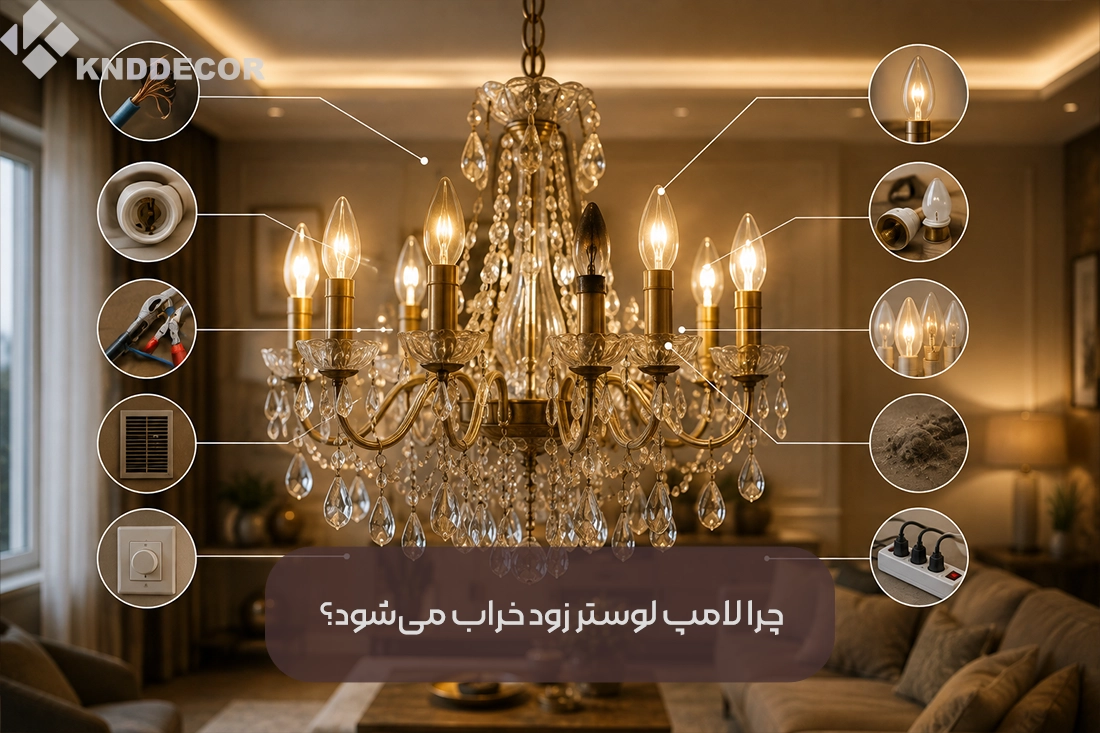
Why do chandelier bulbs burn out quickly? 10 common reasons and how to prevent them
-
 نویسنده:
کارشناس فروش
- تاریخ انتشار:
- Reading time: 6 minutes

-
نویسنده:
کارشناس فروش
- تاریخ انتشار:
- Reading time: 6 minutes
The premature failure of chandelier bulbs is a problem many people encounter after installation. Sometimes, a bulb stops working just a few weeks or months after purchase, raising the question: is the problem with the bulb itself, or the chandelier and the building’s electrical system?
The truth is that premature bulb burnout does not always mean the bulb is low quality. Factors such as power surges, excessive heat, improper connections, using a bulb incompatible with the socket, and even frequent switching on and off can reduce a bulb’s lifespan.
In this article, we examine the most important reasons for rapid chandelier bulb failure and solutions to extend their lifespan.
1. Power Surges: One of the most important causes of bulb failure
One of the most common reasons for the premature failure of LED bulbs is voltage fluctuation.
When the input voltage constantly fluctuates, the electronic components inside the bulb are put under stress. If the fluctuations are severe or frequent, the bulb’s internal circuitry may be damaged.
If you notice that various bulbs throughout your home are also failing quickly, it is best to check for potential issues in the building’s electrical system.
Solution
If bulb failure repeats in several parts of the house, having a professional electrician inspect the electrical system can identify the source of the problem.
2. Excessive heat can reduce the lifespan of LED bulbs
Heat management is a crucial factor in the lifespan of LED bulbs.
If a bulb is placed in a completely enclosed fixture, the heat it generates cannot be dissipated effectively. Rising temperatures can negatively impact the bulb’s internal components.
This issue is particularly important in certain chandelier models that have fully enclosed globes or covers.
Solution
Before purchasing a bulb, check whether the chosen model is suitable for use in enclosed lamps or fixtures.
3. Using a bulb incompatible with the chandelier
Not every bulb is suitable for every chandelier.
A bulb may be incompatible with the chandelier in terms of size, wattage, base type, or appearance.
When purchasing, you should check factors such as:
- Socket type
- Power consumption (Wattage)
- Operating voltage
- Bulb dimensions
- Lamp type
- Installation conditions
For example, if your chandelier has an E27 socket, you must select a bulb with the same base.
4. Low bulb quality
Sometimes, the reason for rapid failure is actually the bulb itself.
Low-quality bulbs may use weaker electronic components, improper heat dissipation systems, or less durable internal circuitry.
A low price does not always mean a more economical choice; if you are forced to replace the bulb multiple times in a short period, the final cost will be higher.
Solution
When buying a bulb, pay attention to build quality, technical specifications, warranty, and the manufacturer’s reputation.
5. Excessive switching on and off
Some bulbs are more sensitive to frequent switching on and off.
If a light is turned on and off many times throughout the day, this cycle can affect the lifespan of certain light sources and electronic components.
Of course, this also depends on the type and quality of the bulb.
If a light is constantly turned on for very short durations, it is better to use a bulb that is suitable for this type of usage.
6. Problem with the lamp socket
Sometimes the problem is not the bulb, but the lamp socket is faulty.
Loose connections, socket wear, or incomplete contact can prevent electricity from reaching the bulb properly.
In such conditions, the bulb may:
- Flicker.
- Turn on and off intermittently.
- Turn on with a delay.
- Fail very quickly.
If only one bulb fails repeatedly in a specific socket while other bulbs have no issues, it is more likely that the socket itself is faulty.
If you notice unusual symptoms, leave the socket inspection to a specialist.
7. Loose bulb in the socket
The bulb must be seated correctly in the socket.
If there is no proper connection, the electrical contact may become unstable, causing interruptions or flickering.
When installing, tighten the bulb sufficiently, but avoid applying excessive pressure.
8. Using an unsuitable dimmer
If your chandelier is connected to a dimmer, you must ensure that the bulb used is compatible with it.
Not all LED bulbs are dimmable.
Using a standard LED bulb with an incompatible dimmer can cause issues such as:
- Flickering
- Failure to turn on fully
- Unnatural light fluctuations
- Reduced bulb lifespan
.
Therefore, if the chandelier is connected to a dimmer, be sure to select a dimmer-compatible bulb.
9. Inadequate ventilation around the chandelier
The installation location of the chandelier can also affect the bulb’s lifespan.
If there is insufficient space for air circulation around the bulb, heat will build up around it.
This is particularly important in chandeliers that have multiple bulbs close to each other.
Choosing the appropriate wattage and paying attention to the surrounding space can help reduce heat buildup.
10. Building wiring issues
In some cases, frequent bulb failure may be due to the building’s wiring.
Faulty connections, circuit issues, or other electrical system defects can cause abnormal light performance.
If, alongside bulb failure, you observe symptoms such as the following:
- Continuous flickering
- Unusual noise
- Abnormal overheating of the socket
- Burning smell
- Sparking
It is best to turn off the light and have a professional electrician inspect the electrical system.
Why is my chandelier's LED bulb flickering?
A flickering bulb does not always mean it is burnt out.
Potential reasons include:
- Voltage fluctuations
- Improper connection
- Faulty socket
- Incompatibility with the dimmer
- Internal circuit failure within the bulb
- Presence of very low current in the circuit under certain conditions
.
If the flickering persists after replacing the bulb, it is best to check the circuit and connections for issues.
Does the number of bulbs in a chandelier affect their lifespan?
The number of bulbs does not inherently cause them to fail quickly; however, a large number of bulbs in an enclosed space can generate more heat.
For example, a chandelier with many bulbs inside enclosed shades creates different thermal conditions compared to an open chandelier.
Therefore, the total power consumption and heat dissipation conditions must also be taken into account.
How can we extend the lifespan of chandelier bulbs?
To prevent premature bulb failure, you can follow a few simple tips:
Choose the right bulb
Check the base type, wattage, voltage, and installation requirements.
Prioritize quality
Instead of focusing solely on price, also examine the build quality and technical specifications.
Use bulbs compatible with your chandelier
If the chandelier has enclosed shades, choose a bulb suitable for such conditions.
Take connections seriously
A loose bulb or a faulty socket can cause damage.
Use a suitable dimmer
If using a dimmer, the bulb must be dimmable and compatible with it.
Keep the chandelier clean
Dust accumulation on and around the light can affect heat dissipation and light quality in certain designs.
How can we tell if the problem is the bulb or the chandelier?
A simple way to perform an initial check is to replace the bulb with a known working and compatible one.
If the new bulb also fails in the same socket, the issue is likely with the socket or the circuit.
If only one specific model or bulb is problematic while other compatible bulbs work correctly, it is more likely that the bulb itself is faulty.
Of course, a detailed inspection of electrical issues should be performed by a professional.
Is a higher wattage bulb a better choice?
Not necessarily.
Choosing a bulb with higher wattage without considering the chandelier’s specifications can lead to increased power consumption and heat.
If you need more light, it is better to first check the range of wattage and bulb types that the chandelier supports.
Sometimes, instead of using a single high-wattage bulb, using several appropriate bulbs or choosing a chandelier with a better design for light distribution yields better results.
What is the best bulb for a chandelier?
A suitable bulb should be compatible with the chandelier’s features and your space’s requirements.
When choosing, consider the following:
Base Type: Compatible with the chandelier socket
Wattage: Compatible with the fixture’s capacity
Brightness: Based on lumens
Color Temperature: Suitable for the home atmosphere
Dimensions: Compatible with the glass shade and chandelier design
Dimmability: If a dimmer is used
Thermal Conditions: Suitable for the type of lamp and enclosure
For this reason, a single bulb model cannot be introduced as the best option for all chandeliers.
Summary
If your chandelier bulbs keep burning out, it is better to find the root cause before immediately buying a new one.
Power surges, excessive heat, low-quality bulbs, faulty sockets, improper connections, incompatible dimmers, and choosing a bulb unsuitable for the chandelier are among the most important factors that can reduce bulb lifespan.
Choosing the right bulb is not limited to brightness alone. The base type, wattage, thermal conditions, color temperature, and compatibility with the electrical system are also important.
If you intend to buy a chandelier, it is best to consider the type of bulb used, the number of sockets, ease of bulb replacement, and heat dissipation from the start. A proper chandelier should be technically compatible with standard bulbs in addition to having a beautiful appearance.
Finally, if a bulb repeatedly fails in a specific socket, or if you notice signs such as a burning smell, sparks, unusual noises, or overheating along with the failure, it is better to have the electrical system and connections inspected by a professional instead of constantly replacing the bulb.