

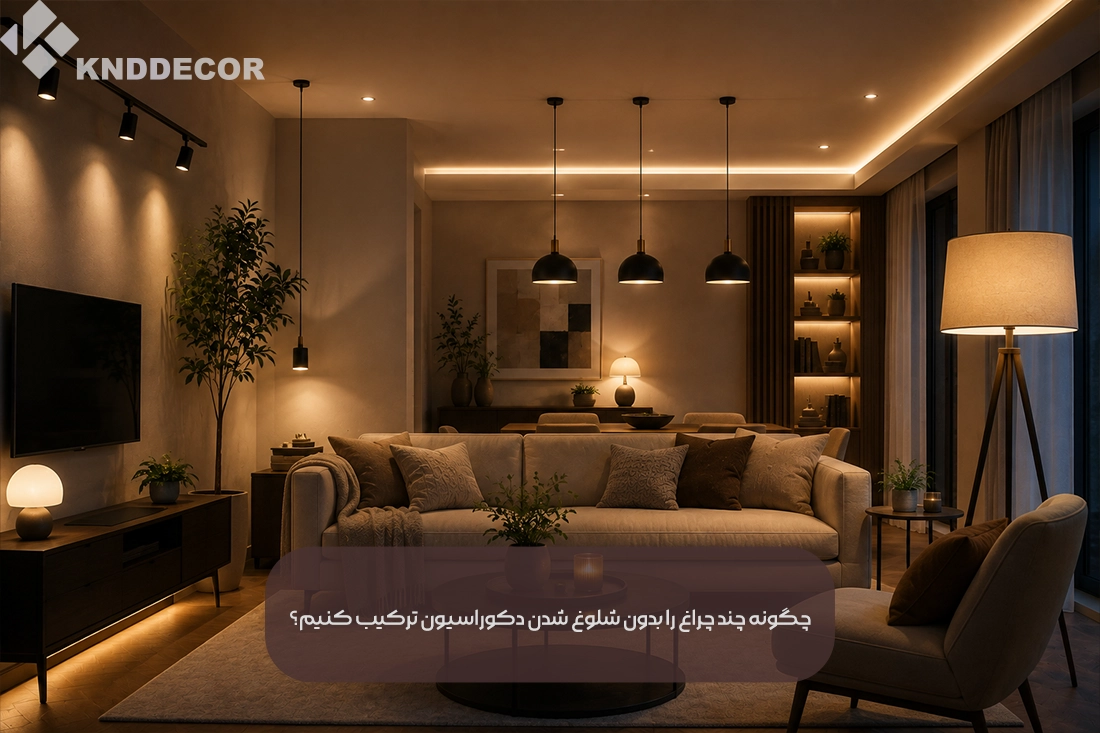
How to Combine Multiple Lights Without Cluttering Your Decor?
-
 نویسنده:
کارشناس فروش
- تاریخ انتشار:
- Reading time: 6 minutes

-
نویسنده:
کارشناس فروش
- تاریخ انتشار:
- Reading time: 6 minutes
Using multiple lights in a home can make the interior brighter, more functional, and more beautiful; however, if lights are chosen and installed without a plan, the result can be quite the opposite. A multitude of chandeliers, floor lamps, wall sconces, pendant lights, and ceiling lights can make the decoration look cluttered and disorganized.
The solution is not to minimize the number of lights; rather, you must create harmony between different light sources. Proper lighting should determine what role each lamp plays, where it is placed, and how it interacts with other light sources.
In this article, we explore how to use multiple lights together without making your home decor look cluttered.
Why does combining multiple lights sometimes cause clutter?
One of the main reasons for a cluttered decoration is choosing lights individually without considering the overall vision of the space.
For example, we might consider a classic chandelier, a modern floor lamp, several industrial wall sconces, and different ceiling lights beautiful on their own; but placing all these elements in one room does not necessarily yield a good result.
Clutter usually occurs when:
- The styles of the lights are different from each other.
- Too many decorative lights are placed in one spot.
- All light sources have high intensity.
- The colors of the lights are not coordinated with each other.
- Lights are chosen without regard to the furniture.
- Every light tries to play the role of the main decorative element.
Therefore, before purchasing any light, you must determine which light source is the main element and which one is the complementary source.
1. Choose one light as a focal point
One of the most important principles to prevent clutter is to choose only one element as a focal point.
In many living rooms, the chandelier takes on this role.
If you have chosen a large and striking chandelier, it is better for the other lights to be simpler.
For example:
Chandelier: Main element
Floor lamp: Simple and minimalist
Ceiling lights: Low-profile and functional
Wall sconces: Delicate and harmonious
This method prevents the eye from wandering aimlessly between various elements.
2. Not all lights should look the same
Coordination does not mean being identical.
It is not necessary for all the lights in your home to be the exact same model. In fact, using different models can create more visual interest, provided they share a common element.
This common element could be one of the following:
- Body color
- Material
- Overall shape
- Light color (color temperature)
- Design style
For example, you can pair a gold chandelier with a lampshade that features gold details. The design of the two lights doesn’t have to be completely identical.
3. Consider a color palette for your lights
The color of the light fixtures is one of the most important factors in creating harmony.
If you are using multiple lights in a single room, it is better if their primary colors do not clash intensely.
For example:
Warm Combination:
Gold + Bronze + Cream
Modern Combination:
Black + White + Metal
Luxury Combination:
Gold + Glass + Neutral Colors
If your lights have too many diverse colors, the interior space may appear more cluttered than usual.
4. Coordinate the light color
Even if the appearance of the lights is coordinated, a drastic difference in light color can ruin the result.
Imagine a chandelier producing warm light, a lampshade with very yellow light, and a ceiling light producing bright white light.
Each of these sources might be suitable on its own, but together they can create a sense of inconsistency.
For residential spaces, it is better for the light colors of the main sources to be close to each other.
In spaces like living rooms and bedrooms, warm light usually creates a more cozy atmosphere. For kitchens or workspaces, natural light or brighter colors can be used.
5. Use the three-layer lighting rule
To achieve professional lighting, it is best to categorize light sources based on their function.
Ambient Lighting
Its task is to illuminate the entire space.
Examples include:
- Chandeliers
- Ceiling lights
- Recessed lights
Task Lighting
Used for performing specific activities.
Examples include:
- Reading lamps
- Under-cabinet lighting
- Bedside lamps
Accent Lighting
Used to highlight a specific element.
Examples include:
- Picture lights
- Shelf lighting
- Decorative plant lighting
With this categorization, every lamp has a specific reason for being in the space, preventing the addition of unnecessary lights.
6. Do not turn on all lights at the same time
One of the simplest ways to avoid clutter is to use independent switches.
For example, in a living room, you can have three lighting circuits:
First circuit: Chandelier
Second circuit: Ceiling lights
Third circuit: Floor lamps or decorative lights
In this case, you can choose the appropriate lighting for each situation.
For watching a movie, perhaps only hidden lighting and a floor lamp are enough; whereas during a party, you can also turn on the chandelier and ambient lights.
7. Coordinate the number of lights with the size of the space
The appropriate number of lights for a room depends on its size.
A large living room may require several light sources, but using the same number of lights in a small room can make the space feel cluttered.
Therefore, before purchasing lights, consider these factors:
- Room area
- Ceiling height
- Amount of furniture
- Wall color
- Amount of natural light
- Room usage
In small spaces, light quality and placement are usually more important than the number of lights.
8. Do not place large lights next to each other
If you have a large, eye-catching chandelier, placing several large decorative lights in the same area can cause visual competition.
It is better to distribute large elements throughout different points of the space.
For example:
- Chandelier in the center of the living room
- Floor lamp in a corner of the seating area
- Decorative lamp on the console
- Wall sconce on another part of the wall
This spacing creates balance in the decoration.
9. Vary the height of the lights
Placing all light sources at the same height can cause monotony or visual clutter.
It is better to place light sources at different heights.
For example:
Ceiling: Chandelier
Eye Level: Wall Sconce
Beside Furniture: Floor Lamp
Table Surface: Table Lamp
This variation in height creates depth in lighting.
10. Coordinate lighting with furniture
One common mistake is choosing lights without considering the furniture layout.
For example, if you have a large sofa in a corner, placing a floor lamp next to it can be both functional and aesthetically pleasing.
Additionally, a pendant light over a dining table should be chosen relative to the table’s size.
Instead of buying a lamp first and then looking for a place for it, it is better to determine the space layout first.
11. Define a specific task for each light
Before buying any lamp, ask yourself:
What exactly does this light do?
If you don’t have a clear answer, you probably don’t need that lamp.
For example:
- Chandelier = General lighting
- Floor Lamp = Reading and decorative light
- Wall Sconce = Accent/Side lighting
- Under-cabinet light = Task lighting for countertops
- Hidden/Cove lighting = Creating depth and visual space
This method prevents buying unnecessary lamps.
12. Use a dominant style
If the home decoration is modern, it is better to choose most lights within that same design range.
For classic decoration, you can use crystal chandeliers, classic lamps, and matching wall sconces.
In Neoclassic style, a combination of simple and elegant lights usually yields great results.
Of course, you can mix styles, but this requires more precision.
13. In small homes, light less, but more intelligently
In small apartments, excessive use of decorative lights can make the space look cluttered.
In such cases, it is better to use one appropriate main light and a few complementary light sources.
For example:
Simple chandelier + floor lamp + cove lighting
can work much better than:
Large chandelier + several pendants + several wall sconces + multiple ceiling lights
.
14. Use cove lighting to create balance
Cove lighting usually doesn’t occupy much visual space, making it an excellent option for completing your lighting setup.
Using cove lighting in:
- False ceilings
- Behind the TV
- Shelving
- Under cabinets
can create more brightness without placing too many visible fixtures in the environment.
15. Before buying a chandelier, look at the entire lighting system
If you intend to buy a chandelier, it is better not to look at the chandelier alone.
Look at the lights you currently have in the room and see what role the new chandelier is intended to play.
If floor lamps, wall sconces, and cove lighting are already present, it might be better to choose a simpler chandelier.
But if the chandelier is meant to be the only main decorative element, you can choose a more striking model.
Suggested combinations to avoid clutter
Modern Living Room
Simple and striking chandelier + minimalist floor lamp + cove lighting
Classic Living Room
Crystal chandelier + matching wall sconces + classic floor lamp
Bedroom
Low-profile chandelier + two bedside lamps
Kitchen
Ceiling lights + island pendants + under-cabinet lighting
Home Office
Simple ceiling light + desk lamp
In all these combinations, the key point is that each light source should have a specific role.
Common mistakes in combining multiple lights
Using too many diverse lights
A large difference in shape and style can ruin the harmony.
Using excessive light
More brightness does not always mean better lighting.
Choosing lights without considering decoration
A light should be part of the overall home design.
Combining contrasting light colors
A sharp difference between warm and cold light can make the environment look inconsistent.
Placing all lights in one spot
It is better to distribute light sources at different points in the space.
Checklist for choosing multiple lights for a space
Before buying, ask yourself these five questions:
1. What is the main light source of the space?
2. What is the purpose of each supplementary light?
3. Are the colors and styles of the lights harmonious?
4. Do the intensity and color of the lights suit each other?
5. Do I really need all these lights?
If the answers to these five questions are clear, the likelihood of a cluttered decoration will be much lower.
Summary
Combining several lights in a house does not necessarily lead to a cluttered decoration. The problem arises when lights are chosen without a plan, without coordination, and without considering the role of each light source.
To achieve beautiful lighting, first determine a main light source such as a chandelier, and then add supplementary sources like floor lamps, wall sconces, ceiling lights, and cove lighting based on the needs of the space.
Additionally, harmony in body color, design style, light color, size, and placement of the lights is very important.
If you intend to buy a chandelier, look at all the existing light sources in the room before choosing a model. A good chandelier is not meant to compete with other lights; rather, it should create a harmonious lighting system alongside them.
Ultimately, the secret to a bright and stylish decoration is not having a large number of lights; it is ensuring that each light is placed in exactly the right spot with the right purpose.