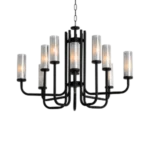
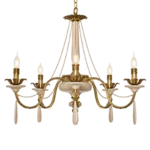
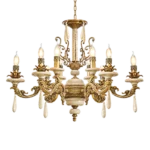
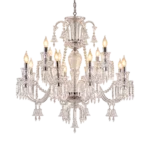


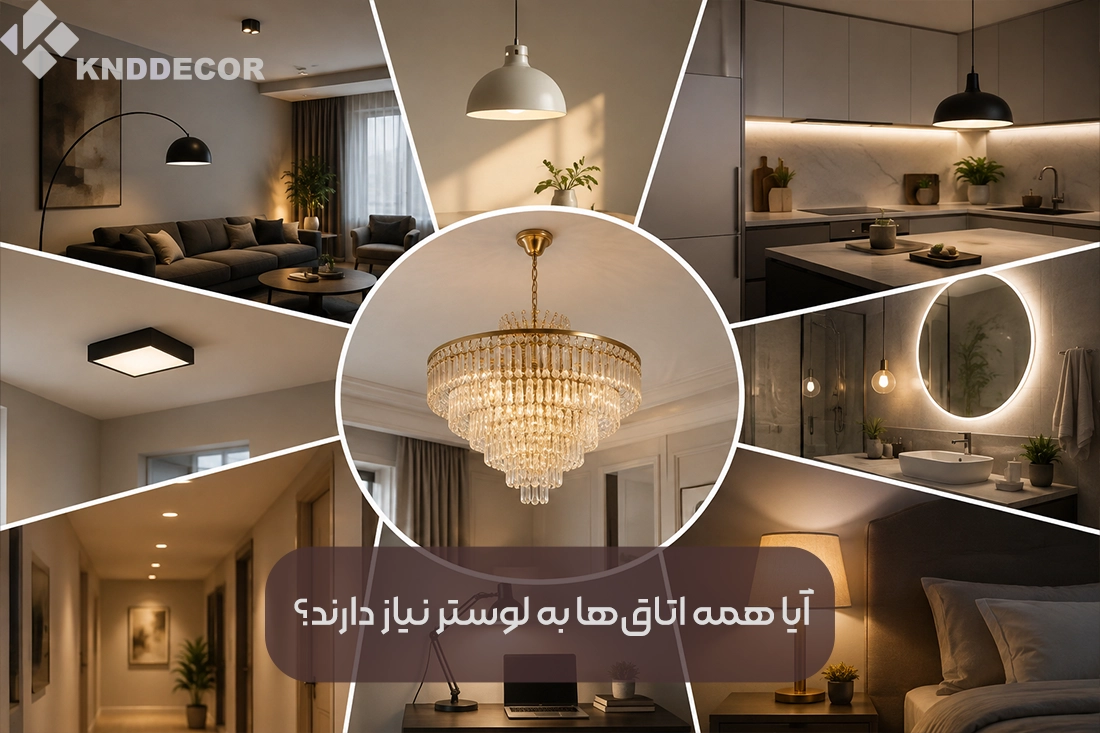
Do All Rooms Need a Chandelier? A Guide to Choosing the Best Lighting for Every Space
-
 نویسنده:
کارشناس فروش
- تاریخ انتشار:
- Reading time: 5 minutes

-
نویسنده:
کارشناس فروش
- تاریخ انتشار:
- Reading time: 5 minutes
When it comes to home lighting, a chandelier is often one of the first options that comes to mind. Beyond providing illumination, a chandelier can play a significant role in the beauty of interior decoration; but is it really necessary to install a chandelier in every room of the house?
The short answer is: No.
Every room has different uses, dimensions, ceiling heights, and lighting needs. For this reason, while a chandelier might be the best choice for a large living room, recessed lighting or ceiling lights might yield better results in a small bedroom or a narrow hallway.
In this article, we will examine which spaces need a chandelier, when it is better to use alternative options, and how to choose the best lighting system for each room.
What role does a chandelier play in home lighting?
A chandelier is not just a device for lighting up an environment. Today, many chandelier models are chosen as one of the primary elements of interior decoration.
A suitable chandelier can:
- Provide general ambient lighting for the space.
- Serve as a focal point of the decoration.
- Make the height and dimensions of the space appear more balanced.
- Enhance the decoration style.
- Add more character and flair to the interior space.
However, all these benefits are realized only when the model and size of the chandelier are in harmony with the intended space.
Does the living room need a chandelier?
In most homes, the living room is one of the best spaces for installing a chandelier.
Living rooms are usually larger than other rooms and require a central light source. Therefore, a chandelier can provide general illumination while also acting as a focal point for the decor.
For large living rooms, multi-arm, crystal, or large modern models can be used. Conversely, for small living rooms, it is better to choose models with proportional dimensions so the space does not appear cluttered.
Of course, it is best to use the living room chandelier alongside other light sources such as cove lighting, ceiling lights, or wall sconces.
Does the bedroom need a chandelier?
A bedroom does not necessarily need a chandelier, but using one can be a suitable choice.
In this space, very intense light is usually not required, as the main goal is to create a calm and comfortable environment. Therefore, a small or medium-sized chandelier with soft light can be an appropriate option.
If the bedroom has a low ceiling, using very long and hanging models may make the room appear smaller. In such cases, ceiling lights or low-profile chandeliers are better choices.
Additionally, a chandelier can be combined with bedside lamps or wall sconces to provide localized lighting for reading or various activities.
Does the kitchen need a chandelier?
The kitchen is a space where lighting choices should be primarily based on functionality.
If the kitchen has an island or a dining table, pendant lights can be an excellent choice. In addition to providing light, these fixtures create a beautiful decorative effect.
However, for the main part of the kitchen, the use of ceiling lights and under-cabinet lighting is of greater importance.
Therefore, in a kitchen, a combination of the following usually yields better results:
- Ceiling lights for general illumination
- Under-cabinet lighting for the workspace
- Pendant lights for the island or dining table
Does a home office need a chandelier?
In a home office, the quality of light is more important than the appearance of the fixture.
While a simple or modern chandelier can be used in the center of the room, having a reading lamp or a desk lamp is also very important.
The light should be sufficient to illuminate the desk surface well so that the eyes are not strained while reading or working on a computer.
For this reason, in a home office, a simple ceiling light combined with a localized light source may be a more practical choice than a large chandelier.
Does a child's room need a chandelier?
Installing a chandelier is not mandatory for a child’s room either.
If you intend to use a chandelier, it is better to choose a model that:
- Has an appropriate height.
- Has parts that do not easily detach.
- Does not have sharp or dangerous edges.
- Does not create glaring light.
- Is proportionate to the dimensions of the room.
In a child’s room, simple ceiling lights or low-profile models can be suitable choices.
Does a hallway need a chandelier?
Hallways are usually not suitable spaces for large chandeliers because they have limited width and high foot traffic.
Low-profile ceiling lights, lighting panels, and recessed lights are usually more practical choices for hallways.
If a hallway has a high ceiling and sufficient width, one or more small pendant lights can be used to create a more decorative look.
Does a bathroom need a chandelier?
In most cases, a chandelier is not a necessary or practical choice for a bathroom.
In these spaces, it is better to use lights that are suitable for humid environments and meet the necessary safety standards.
Proper ceiling lights, mirror lighting, and sufficient lighting for the face are usually more important than a chandelier.
Does a dressing room or closet need a chandelier?
In a dressing room, uniform, shadow-free lighting is very important. Ceiling lights, linear lighting, and inside-closet lighting are usually more practical than a chandelier.
However, if the dressing room is large, a decorative pendant light or a small chandelier can be used as a decorative element.
When is it better to use ceiling lights instead of a chandelier?
In some circumstances, ceiling lights are a more logical choice.
Low Ceilings
If the distance between the ceiling and the floor is short, a hanging chandelier may reduce the visual space.
Small Rooms
In small rooms, a simple ceiling light can provide sufficient brightness without occupying visual space.
High-Traffic Areas
In hallways, entrances, and some workspaces, low-profile lighting is usually more practical.
Need for Uniform Light
If the goal is to create uniform illumination throughout the environment, using several recessed lights or ceiling lights can be better than a single central chandelier.
When is a chandelier the best choice?
A chandelier is an excellent choice when you want to have a prominent decorative element in the space in addition to light.
Using a chandelier is usually suitable for these spaces:
- Living Room
- Sitting Room
- Dining Room
- Large Entrances
- Bedroom
- Spaces with high ceilings
In these spaces, a chandelier can serve as the focal point of the decoration.
Can a house be lit without a chandelier?
Yes. Installing a chandelier is not a necessity for home lighting.
A complete lighting system can be created using a combination of:
- Recessed lights
- Ceiling panels
- Linear lights
- Wall sconces
- Lamps/Floor lamps
- Pendant lights
- Cove lighting
However, chandeliers have another advantage: in addition to lighting, they can serve as an important decorative element.
Therefore, removing a chandelier is not a technical necessity; rather, it is more of a design and decor decision.
Should we choose a different chandelier for every room?
It is not necessary for all rooms in the house to have similar chandeliers. In fact, choosing lighting that matches the use of each space usually yields better results.
For example:
Space | Recommended Option |
Living Room (Reception) | Main chandelier + complementary lighting |
Sitting Room | Chandelier or pendant light |
Bedroom | Small chandelier or ceiling light |
Kitchen | Ceiling light + island pendant |
Home Office | |
Children’s Room | Ceiling light or low-profile chandelier |
Hallway | Ceiling light or recessed light |
Bathroom | Moisture-resistant lighting |
Dressing Room | Linear lighting and ceiling lights |
What are the most important criteria for choosing a chandelier?
If you have decided to buy a chandelier for a room, consider these points before choosing a model:
1. Room Size
The larger the space, the larger the light source or the more light sources are typically needed.
2. Ceiling Height
Ceiling height determines whether a pendant model is suitable or if you should opt for low-profile chandeliers.
3. Decoration Style
The chandelier must be consistent with the overall style of the space; for example, modern, classic, and neoclassical models each have different applications.
4. Required Light Intensity
The number of bulbs, type of bulb, and light distribution should be appropriate for the room’s use.
5. Light Color
For relaxation spaces, warm and soft light usually creates a pleasant feeling, while workspaces may require brighter and more functional light.
Summary
Do all rooms need a chandelier? No. Choosing a chandelier should be based on the use of the space, room dimensions, ceiling height, required light intensity, and decoration style.
Living and sitting rooms are usually the best spaces for using a chandelier, while in hallways, bathrooms, or very small rooms, ceiling, recessed, or linear lights might be a more suitable choice.
On the other hand, even if a room does not need a chandelier, it can be used as a decorative element, provided that its dimensions and design are harmonious with the environment.
Ultimately, the goal of home lighting is not just to illuminate the space. Proper lighting should meet functional needs and also be consistent with the decoration. Therefore, instead of looking for a one-size-fits-all solution for all rooms, choose a lighting system tailored to each specific environment.