

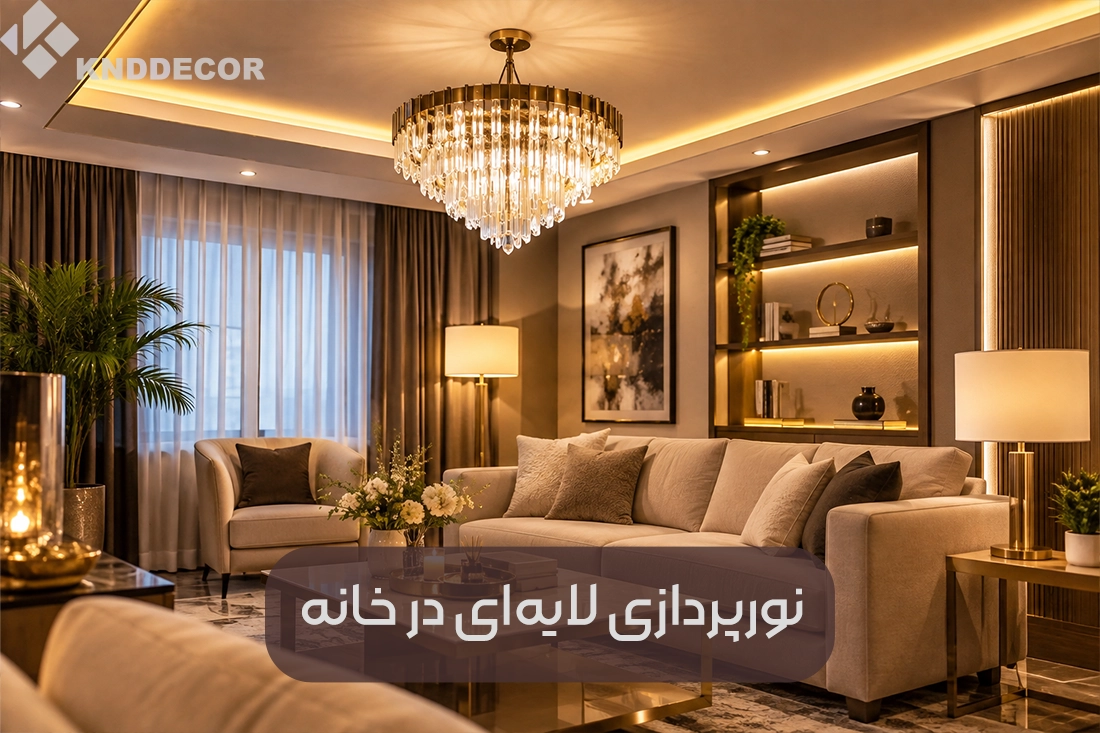
Layered Lighting at Home: How to Create a Professional Space by Combining Chandeliers, Lamps, and Accent Lighting?
-
 نویسنده:
کارشناس فروش
- تاریخ انتشار:
- Reading time: 6 minutes

-
نویسنده:
کارشناس فروش
- تاریخ انتشار:
- Reading time: 6 minutes
When we talk about home lighting, the first thing that usually comes to mind is choosing a beautiful chandelier for the living room or lounge. However, successful lighting is not limited to just a single ceiling light. Even an expensive chandelier, if it is the only light source in the room, cannot showcase the desired space as it should be.
The solution interior designers use to solve this problem is layered lighting; meaning that instead of entrusting all the illumination of a space to a single light source, we combine several types of light with different applications.
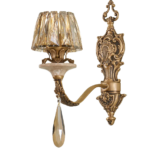
In this method, chandeliers, floor lamps, wall lights, and cove lighting each have a specific task, and ultimately, their combination makes the space both more functional and gives it more depth and charm.
What exactly is layered lighting?
In simple terms, layered lighting means not relying on just one lamp to illuminate a space.
Typically, the lighting of a room can be divided into three main layers:
- Ambient lighting for general illumination of the space
- Task lighting for specific activities
- Accent/Decorative lighting to create mood and emphasize specific areas
These three layers do not necessarily require three different lamps; the key point is that the light sources can work together to cover the various needs of the space.
For example, in a living room, a chandelier might provide the main light, a floor lamp next to the sofa might create a softer glow, and wall lights or cove lighting might emphasize a part of the decoration.
Why is a chandelier alone never enough?
A chandelier is usually the focal point of living room lighting, but its light enters the space from a specific direction. If the home layout, ceiling, walls, or room dimensions are such that the light does not distribute evenly, some areas may appear darker than others.
On the other hand, excessive brightness does not always mean better lighting.
Sometimes, a very strong ceiling light makes the home space look overly formal and flat; whereas by turning off the chandelier and turning on a floor lamp, the same room can achieve a calmer and more intimate atmosphere.
For this reason, when choosing the right chandelier for your living space it is better not to focus only on its appearance, but to think from the beginning about which other light sources it will be used alongside.
The first layer: Ambient lighting and the role of the chandelier
General lighting is responsible for providing the base illumination for a space. In many homes, the chandelier is the primary element of this layer.
Of course, the choice of a chandelier should be coordinated with the room dimensions, ceiling height, decoration style, and even the size of the table or seating area.
For a large reception area, using a small chandelier might make the center of the space look excessively empty. Conversely, an oversized chandelier in a small space can disrupt the visual proportion of the room.
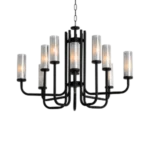
If your home decor leans towards modern designs, exploring modern chandeliers can be a great starting point for choosing your main light source.
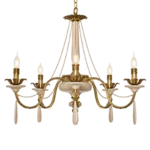
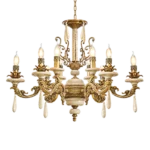
In classic or neoclassical decorations, it is also best to ensure the chandelier’s form harmonizes with furniture details, curtains, wall colors, and other decorative elements.
The second layer; lamps for when you don't want intense light
One common mistake is thinking that a lamp is merely a decorative object.
In reality, a lamp can play a crucial role in controlling the ambiance of a space.
Imagine it’s evening and you don’t want to light up the entire living room with the main light. In such cases, turning on a lamp next to the sofa or in a corner of the room provides sufficient light for reading, conversation, or relaxing, without suddenly illuminating the entire house.
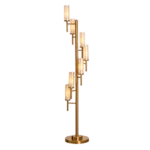
For the living room, using a floor lamp next to a sofa or side table can create an independent light point.
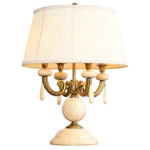
If the space is smaller, table lamps are also a great option. A lamp on a console or side table, in addition to providing light, can add depth to the room’s decorative composition.
The third layer; decorative lighting to highlight details
Decorative lighting is not necessarily used to illuminate the entire room. Its main goal is to emphasize parts that we want to be more visible.
For example:
- A painting on the wall
- A mirror
- A bookshelf
- A console
- Decorative accessories
- A specific wall texture
- A corner of the living area
This type of lighting encourages the eye to move through the room, ensuring everything isn’t just limited to the central chandelier.
In such cases, even decorative mirrors can become part of the lighting design; because the mirror surface reflects light, it can make the interior space appear brighter and more open.
Should all lights be the same shape?
No; in fact, all lighting elements do not need to be exactly the same.
One of the more attractive methods in interior design is to have lights with different forms but a common characteristic.
This common characteristic could be the metal color, color spectrum, design style, or even the type of light.
For example, a main chandelier might have a modern form, while a selected table lamp has a simpler design. If the body color and light temperature of these two are coordinated, the final combination will still look cohesive.
On the other hand, choosing several very different lamps without any visual connection may make the decoration look cluttered.
Light temperature; details that should not be ignored
Even if you choose the best chandelier and table lamp, inconsistent light colors can ruin the final result.
Warm light usually creates a greater sense of intimacy and is a popular choice for spaces like living rooms and bedrooms. Neutral lights can also be suitable for spaces that require clearer visibility.
The important point is not to create a severe difference between the light colors of various sources within a single space.
Suppose a chandelier has very warm light, but the table lamp next to the sofa produces completely cool light. Instead of creating variety, this contrast may make the lighting look unnatural.
What to do in a large living room?
In large spaces, layered lighting becomes more important.
A single central chandelier might not be enough to illuminate the entire space. In these cases, a combination of several light sources can be used.
For example:
Central chandelier + Floor/Table lamp + Wall light + Hidden/Ambient light
This combination ensures that each part of the living area has its own lighting function.
If the ceiling is very high, the choice of chandelier becomes even more important; because in addition to providing light, the lamp plays a role in determining the visual scale of the space.
How to light a bedroom?
The bedroom does not require very intense or uniform light. In this space, it is usually better to have controllable main lighting alongside auxiliary light sources.
A simple chandelier in the center of the ceiling can provide general lighting. Then, bedside lamps or a decorative light can be used to create localized lighting.
If you intend to choose a ceiling light for the bedroom, it is best to pay attention to the light intensity, the size of the room, and the dominant color of the decoration in addition to the product’s appearance.
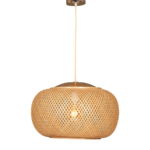
In such spaces, using bedroom pendants and chandeliers can help create a more subtle central light.
A major mistake: increasing the number of lights
Layered lighting does not mean increasing the number of lights.
The goal of this method is the intelligent use of light sources, not having a light in every corner of the house.
If we fill a small room with several different light sources, the final result may be cluttered and annoying.
Before buying a lamp, it is better to ask yourself:
What exact lighting problem in the space does this lamp solve?
If you do not have a clear answer to this question, you probably do not need that lamp.
Choose the combination of chandeliers and lamps based on the layout
One of the best methods for lighting design is to start from the actual layout of the home.
Consider the placement of sofas, dining tables, consoles, TVs, and other elements, and then decide what type of light each part needs.
For example, if a corner of the living room is a reading area, a floor lamp could be a more logical choice. If a console is placed against a wall, a table lamp or decorative light can highlight that section.
Ultimately, the chandelier performs the task of general lighting, and smaller sources complement the space.
Before buying, prepare a simple lighting map
You don’t need professional software for this.
Take a piece of paper and draw a simple plan of the room. Mark the location of windows, furniture, the dining table, and important points.
Now ask yourself three questions:
- Where is the main light supplied from?
- Which parts are darker during the night hours?
- At what times do I not want the main light to be on?
The answers to these three questions usually determine what kind of supplementary light you need.
Summary; a beautiful home does not just need a chandelier
A chandelier can be a very important focal point in decoration, but professional lighting is usually not limited to a single light source.
The correct combination of ambient, task, and accent lighting ensures that your home has a different look at various hours of the day and night.
Sometimes you may need the full light of a chandelier for a family gathering; a few hours later, the light from just a single floor lamp might be enough for watching TV or relaxing.
For this reason, when choosing lighting equipment, it is better to think about the entire home lighting system rather than buying each lamp individually.
If you are designing your home decoration from scratch, choose your chandelier based on the dimensions of the space and the decoration style, and then complete the lighting layers using floor and table lamps and other light sources.
Ultimately, the best lighting is not necessarily the brightest; good lighting is light that is placed exactly in the right place at the right time.