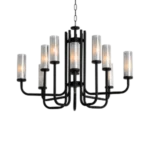
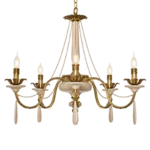
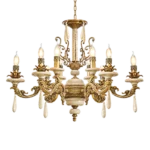
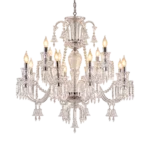
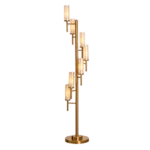
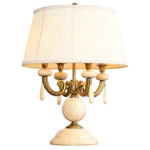
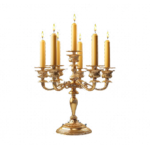
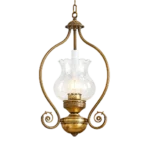


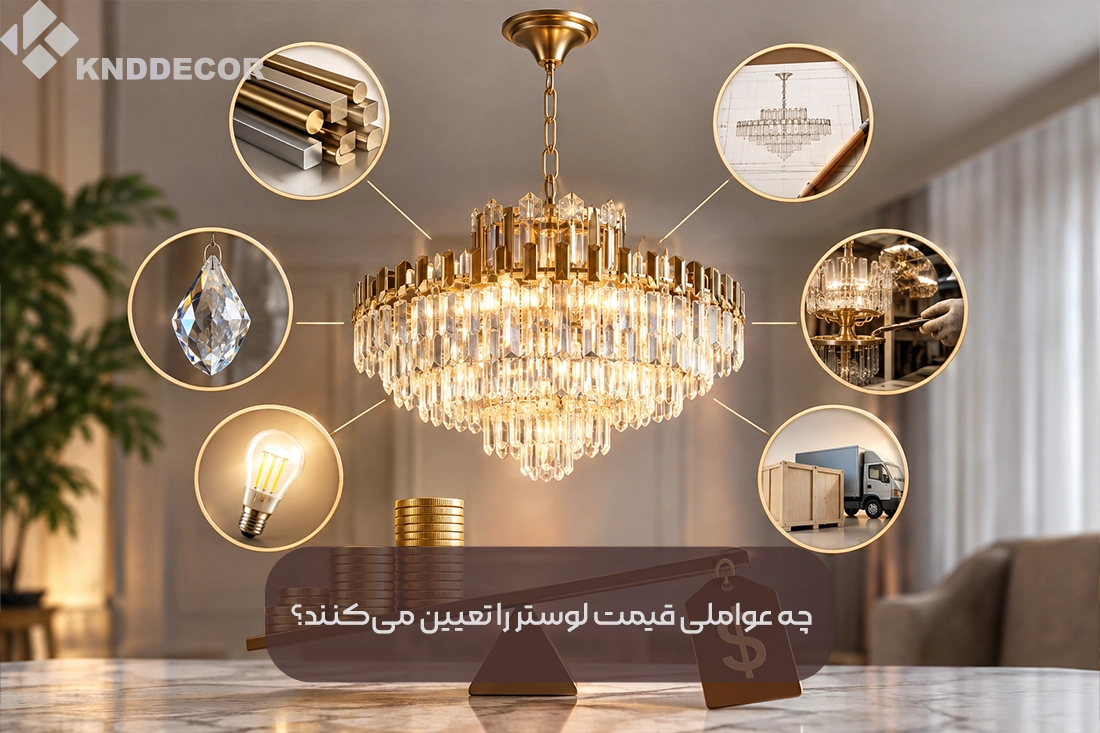
What factors determine the price of a chandelier? A complete guide before buying
-
 نویسنده:
کارشناس فروش
- تاریخ انتشار:
- Reading time: 6 minutes

-
نویسنده:
کارشناس فروش
- تاریخ انتشار:
- Reading time: 6 minutes
For many buyers, the price of a chandelier is one of the most important criteria when choosing a product. Two chandeliers may look similar, but they can have a significant price difference. The reason for this difference is usually not just the brand or appearance; rather, a combination of factors such as body material, plating type, number of arms, dimensions, crystal type, lighting system, manufacturing quality, and design affects the final price.
For this reason, comparing chandelier prices without considering their specifications can lead us to choose a product solely because it is cheaper, even if its quality or features do not match our needs.
In this article, we examine what factors determine the price of a chandelier and what points to consider when comparing different models.
Why do chandelier prices vary?
The price of a chandelier is the result of combining several different factors. For example, two models might both be gold, but one may have a metal body with high-quality plating, while the other has a body made of more economical materials.
Additionally, the number of parts, weight, production method, design, and even the type of packaging can affect the price.
Therefore, for a proper comparison, instead of just asking “How much does this chandelier cost?”, it is better to ask:
What quality and specifications is this price set against?
1. Chandelier Body Material
One of the most important price-determining factors is the chandelier body material.
Chandeliers can be made from various materials, such as:
- Metal
- Brass
- Aluminum
- Iron
- Glass
- Crystal
- Mixed materials
The type of material, its thickness, and the manufacturing quality can create a significant price difference.
For example, a chandelier with a heavy metal body and precise construction is usually not comparable to a lightweight, economical model.
Therefore, when buying, do not only pay attention to the color of the body; also inquire about the primary material of the body.
2. Plating and Color Quality
The gold, silver, black, or bronze appearance of a chandelier does not determine its quality on its own.
The type and quality of the surface coating or plating can affect the price.
Proper plating should:
- Be uniform.
- Have a desirable appearance.
- Not have severe color variations in different parts.
- Be selected in accordance with the underlying material and production method.
For this reason, two chandeliers with a similar visual color may have different prices.
3. Number of Arms
In many models, increasing the number of branches increases the amount of raw materials and parts used, which can consequently drive up the price.
For example, a three-branch model typically differs from a larger eight or ten-branch model in terms of material quantity and components.
However, more branches do not always mean higher quality.
When purchasing, you should choose the number of branches based on your space, rather than simply to have a more expensive or larger chandelier.
4. Chandelier Dimensions and Size
The size of the chandelier can also impact the price.
Large chandeliers usually require:
- More raw materials
- More components
- Larger packaging
- Different installation equipment
For this reason, large and multi-tier models usually have higher prices compared to smaller models.
Of course, price is not determined by size alone, and the quality of materials remains highly important.
In crystal chandeliers, one of the key price factors is the type and quality of the crystals.
Crystals can differ from one another in terms of:
- Clarity
- Cut
- Shape
- Thickness
- Visual appearance
- Light reflection
The number of crystals used is also significant.
Therefore, two chandeliers with nearly identical designs may have different prices due to differences in their crystal components.
6. Design and Manufacturing Complexity
A chandelier with a simple design usually has a different manufacturing process than a complex, multi-layered model.
Models that feature:
- Multiple branches
- Unique forms
- Numerous decorative parts
- Multi-tier structures
- Handcrafted details
- Complex connections
may have higher production costs.
In some models, a significant portion of the price is related to the design and production process, not just the raw materials.
7. Handmade vs. Industrial Production
The production method can also affect the price of a chandelier.
Mass-produced products usually follow a standard process and have higher production volumes.
In contrast, some chandeliers feature handmade components or more extensive assembly and finishing stages.
If a product is produced in limited quantities or with more intricate details, it is natural for its price to differ from a mass-produced model.
8. Type of Lighting System
The lighting system of a chandelier can also impact its price.
For example, a chandelier might:
- Use screw-in bulbs.
- Utilize integrated LEDs.
- Have color-changing capabilities.
- Include a dimmer.
- Be remote-controlled.
- Be compatible with smart home systems.
The more technical features a product has, the higher the cost of the equipment and technology used may increase.
9. Quality of Electrical Components
The appearance of the chandelier is not the only important factor.
Components such as:
- Sockets
- Wiring
- Connectors
- LED drivers
also play a role in the overall quality of the product.
Using proper components can affect the durability, performance, and safety of the lighting system.
Therefore, when comparing two chandeliers, it is best to examine their technical specifications as well.
10. Brand and Manufacturer Reputation
The brand can also be one of the factors affecting the price.
Brands with a longer history, exclusive designs, strict quality control, and established after-sales services may offer their products at different price points.
Of course, a brand being more expensive does not, by itself, guarantee a better product.
It is better to evaluate the price alongside build quality, technical specifications, and the services provided.
11. Warranty and After-Sales Service
The availability of a warranty and after-sales services can also play a role in the final price of the product.
If a seller or manufacturer offers specific services for the product, it can increase its value for purchase.
Before buying, it is better to ask about matters such as:
- Warranty period
- Warranty terms and conditions
- Covered parts
- Repair services
- Spare parts availability
- Replacement conditions
Ask questions.
12. Assembly Quality
Two chandeliers may be made of similar materials but have different assembly qualities.
In a product with precise assembly:
- Connections are more orderly.
- Branches are better aligned.
- Parts are not loose.
- Wiring is neater.
- The final appearance of the product is more uniform.
Assembly quality is one of the aspects that can be better inspected during an in-person purchase.
13. Chandelier Weight
Weight can also affect the price to some extent, as heavier products usually use more materials.
However, more weight does not necessarily mean higher quality.
A lightweight chandelier can be a high-quality product due to proper design and the use of standard materials.
Therefore, weight should be considered alongside the material and structure of the product.
14. Number of Parts and Decorative Details
The more decorative parts there are, the more production and assembly costs may increase.
This is more commonly seen in classic and crystal chandeliers.
For example, a multi-tier chandelier with many crystals, metal parts, and various decorations naturally has a more complex production process compared to a minimal model.
15. Bulb Type and Maintenance Cost
The type of bulb may not directly constitute a large portion of the chandelier’s price, but it does affect its overall value.
For example, with an integrated LED chandelier, you should have sufficient information regarding the possibility of replacing or repairing the light source and the driver.
In models with sockets, you should also check the bulb base type and the ease of access to the bulb.
16. Smart Features
Some modern chandeliers offer features such as:
- Remote control
- Dimmable brightness
- Color temperature adjustment
- Mobile phone control
- Smart home system integration
The presence of these features usually increases the price compared to simpler models.
If you do not require these features, a simpler model might be a more economical and logical choice.
17. Packaging and Shipping Costs
Chandeliers, especially large and crystal models, require protective packaging.
The more delicate, larger, or heavier the product, the more complex its packaging and transport can become.
Of course, these costs are not calculated the same way in all stores; some may be included in the final product price or as a separate shipping fee.
18. Chandelier Design Style
The design style can also influence the price.
For instance, chandeliers in styles such as:
- Modern
- Classic
- Neoclassic
- Crystal
- Minimalist
- Multi-tier
differ in terms of design, raw materials, and manufacturing processes.
However, a higher price due to a specific style name should not be automatically assumed to be a sign of higher quality.
19. Customization
If it is possible to order a chandelier with:
- A specific color
- Custom dimensions
- A different number of branches/arms
- A specific light color
- A different combination of materials
the price may be higher than the standard model.
This is because custom production usually requires separate time and processes.
20. Fluctuations in raw material and market prices
The price of raw materials such as metal, glass, crystal, and electrical components is not fixed.
For this reason, the price of a chandelier model may change over time.
Production costs, transportation, the import of certain parts, and market conditions can also affect the final price.
Therefore, it is best to check the product price along with the exact date and model specifications.
Is a more expensive chandelier always better?
No.
A higher price alone cannot guarantee the quality of a chandelier.
A model might be more expensive due to larger dimensions or more decorations, but it may not be the right choice for your space.
On the other hand, a simpler chandelier at a more reasonable price might completely meet your lighting and decorative needs.
Therefore, when buying a chandelier, it is better to focus on value for money instead of the absolute price.
What should we consider when buying an affordable chandelier?
A low price does not always mean a bad choice. Some budget models have more reasonable prices due to simple design, fewer parts, or high-volume production.
However, before purchasing a budget model, check these items:
- What is the body material?
- How is the plating quality?
- What is the quality of the electrical components?
- Are spare parts available?
- Does it have a warranty?
- What are the actual weight and dimensions?
- Does the product photo match the actual sample?
- What are the return conditions?
If the answers to these questions are clear, you can make a good choice even within an economical price range.
When buying a chandelier, do not just compare prices
One common mistake is when a user only compares the prices of two products.
For example, one chandelier might cost 5 million Tomans while another model costs 8 million Tomans; however, without checking the specifications, you cannot say whether the 8-million-Toman model offers better value for money.
The price difference might be due to:
- Larger size
- More branches/arms
- Higher quality crystals
- Smart features
- Different materials
- More complex design
Therefore, price must be evaluated alongside the product specifications.
Summary
The price of a chandelier does not depend on a single factor. Body material, plating quality, number of branches, dimensions, crystal type, design, manufacturing method, lighting system, quality of electrical components, brand, warranty, and additional features can all play a role in determining the final price.
For this reason, when buying a chandelier, you should not look at the price alone. First, identify your needs, then compare the technical specifications and build quality of several models.
A suitable chandelier is not necessarily the most expensive option available; rather, it is a product that provides quality, beauty, illumination, durability, and features proportional to your needs in exchange for the cost you pay.
Ultimately, the best way to compare chandelier prices is to ask, instead of “Which chandelier is cheaper?”:
What quality and features am I receiving in exchange for the amount I am paying?