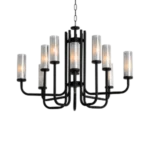
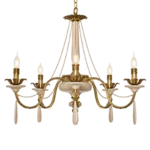
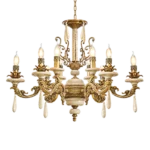
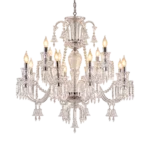


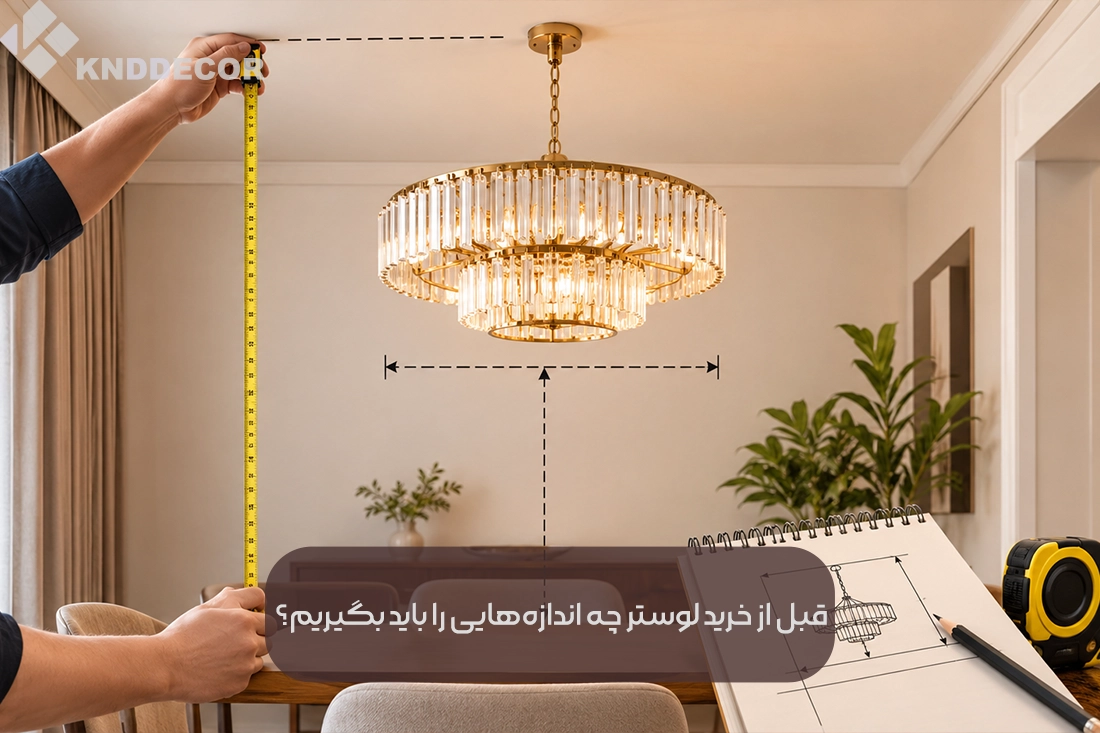
What measurements should you take before buying a chandelier? A guide to accurate measuring
-
 نویسنده:
کارشناس فروش
- تاریخ انتشار:
- Reading time: 7 minutes

-
نویسنده:
کارشناس فروش
- تاریخ انتشار:
- Reading time: 7 minutes
One of the most common mistakes when buying a chandelier is focusing only on its appearance and ignoring the dimensions of the installation space. A chandelier might look beautiful in a photo, but after installation, you might realize it is too large, has an inappropriate height, or does not harmonize well with your table and furniture.
To avoid such problems, it is better to take several important measurements at home before buying a chandelier and use them when selecting a product.
Measuring is not just for the living room. If you intend to buy a chandelier for a bedroom, kitchen, dining table, entryway, or any other space, knowing the dimensions of the environment will help you make a more accurate choice.
In this article, we will examine which measurements you should take before buying a chandelier and the purpose of each measurement.
Why is measuring important before buying a chandelier?
A chandelier must harmonize with its surrounding space.
If the chandelier is too small, it may get lost in a large space and fail to have a sufficient decorative impact.
If it is too large, it can make the space feel cluttered or even restrict walkways.
Additionally, an inappropriate chandelier height may cause people to bump into it while passing or result in the light not being positioned correctly.
Therefore, before buying a chandelier, it is better to take a few minutes for measuring.
1. Measure the length of the room
The first measurement you need is the length of the room.
Place the measuring tape from one wall to the opposite wall and note the distance in centimeters.
For example:
Room length: 500 cm
This number is used when determining the overall size of the chandelier and its proportion to the room space.
2. Measure the width of the room
After the length, measure the width of the room.
For example, if your room is:
500 × 350 cm
It will be clear that the intended space is rectangular and what its dimensions are.
This information helps you quickly rule out models that are too large or too small.
3. Measure the ceiling height
One of the most important measurements is the floor-to-ceiling height.
This measurement is crucial for choosing the correct chandelier height.
For example:
- Low ceiling = Flush mount or low-profile chandelier
- Medium ceiling = Standard pendant chandelier
- High ceiling = Long pendant or multi-tier chandelier
Two rooms may have the same square footage, but due to differences in ceiling height, they may require two completely different types of chandeliers.
4. Consider the distance from the installation point to the floor
Ceiling height alone is not enough.
You must determine at what height the chandelier will be installed and how much distance there will be between its lowest point and the floor.
This is especially important in spaces where people walk underneath the chandelier.
The chandelier should not hang so low that it poses a collision risk.
5. If the chandelier is above a table, measure the table dimensions
If the chandelier is intended to hang over a dining table, coffee table, or any other table, the table size is very important.
Measure the length and width of the table.
For example:
Table length: 180 cm
Table width: 90 cm
Now, when shopping, you can choose a chandelier that is dimensionally proportional to the table.
A very small chandelier on a large table may look weak, while an oversized chandelier can disrupt the visual balance of the table.
6. Measure the distance from the ceiling to the tabletop
For chandeliers above a dining table, ceiling height isn’t the only factor.
You must also consider the distance between the ceiling installation point and the tabletop.
This measurement helps you determine the appropriate height for the chandelier.
The goal is for the chandelier to hang low enough to provide adequate light on the table, but not so low that it obstructs the view of people.
7. Determine the exact installation location
One common mistake is assuming that a chandelier must always be placed exactly in the center of the ceiling.
If the chandelier is intended to be installed above a dining table, its center should align with the center of the table, even if the table is not positioned at the exact geometric center of the room.
Therefore, before purchasing, determine:
Exactly where will the chandelier be placed?
This is especially important for multi-functional spaces.
8. Measure the width of the installation area or the surrounding space
If the chandelier is being placed in a specific part of the ceiling, check the surrounding space as well.
For example, if the installation area is surrounded by:
- False ceilings
- Hidden lighting
- Molding/Framing
- Ceiling fans
- AC vents
- Recessed lights
You must determine the distance between these elements and the chandelier installation point.
This prevents collisions or a cluttered appearance on the ceiling.
9. Check the distance between the chandelier and the walls
The chandelier should not be too close to the walls, unless the space design requires it.
If the room is small, consider the distance between the chandelier and the walls so that the chosen model does not occupy too much visual space.
In rectangular spaces, choosing a large round chandelier might also make it look disproportionate to the length of the room.
10. Measure the height of the console or furniture beneath the chandelier
If the chandelier is to be installed above a console, table, or a specific element, measure its height as well.
This will help you better determine the appropriate hanging height for the chandelier.
Additionally, ensure that the chandelier will not interfere with doors, cabinets, or other surrounding elements.
11. Measure the width of the walkway for home entrances
If you are planning to buy a chandelier for your home entrance, ceiling height alone is not enough.
Measure the width of the walkway and check how much clearance the chandelier will have from the passage.
In narrow entrances, large and hanging models may not be suitable.
In such cases, a flush mount or low-profile chandelier is usually a more practical choice.
12. For staircases, measure the height and width of the installation space
Measurement becomes even more critical in staircases.
In addition to the ceiling height, you must check:
- The total height of the staircase area
- The width of the staircase
- The distance of the chandelier from the walkway
- The chandelier mounting point
For high-ceiling and duplex spaces, hanging and multi-tier chandeliers can be a great choice; however, the length of the chandelier must be perfectly coordinated with the available space.
13. For false ceilings, check the ceiling depth
If the house has a false ceiling, you must check the installation conditions before purchasing a chandelier.
If there is a gap between the false ceiling and the main ceiling, determine how much that gap is.
Additionally, the location of the supporting structure and the mounting method must be identified.
This is especially important for heavy chandeliers.
Be sure to also check the weight of the chandelier before purchasing
14. Consider the size of fans or other ceiling equipment
If there is a ceiling fan, light, vent, or other equipment in the same area, measure the distance between them.
The chandelier should not interfere with other ceiling fixtures.
If the chandelier is intended to replace a previous light fixture, the dimensions of the installation site and the existing connections can also be useful.
15. Compare the required number of bulbs with the size of the space
Measurement is not limited to physical dimensions alone.
After determining the square footage of the space, you must consider how much brightness you need.
For example, a large room might not be bright enough with just a small chandelier and three bulbs.
Conversely, a small room with a very bright chandelier might become overly illuminated.
Therefore, consider the size of the space alongside:
- Number of bulbs
- Bulb wattage
- Type of bulb
- Light color
Check these factors carefully.
A simple formula for choosing chandelier diameter
A simple method can be used to approximate the diameter of a chandelier.
Consider the length and width of the room in meters and find their sum. Then, treat this number as an approximate measurement in inches.
For example, if the room is:
5 meters long + 3 meters wide
Then:
5 + 3 = 8
In this case, the approximate diameter of the chandelier could be around 80 centimeters.
This method is only a starting point for choosing a size and should not be considered an absolute rule.
Ceiling height, room shape, chandelier type, and other light sources should also be considered.
Proper chandelier size for a dining table
For a dining table, in addition to the table size, the distance of the chandelier from the edges of the table is also important.
Generally, it is better that the chandelier is not so large that it extends beyond the width of the table, yet not so small that it looks disproportionate on the table.
If the table is large and rectangular, elongated or multi-source models can be suitable options.
For round tables, round chandeliers or models with a central form can create better harmony.
Which dimensions are more important for a multi-arm chandelier?
If you intend to purchase a multi-arm chandelier, in addition to the overall diameter, you should also pay attention to the arm spread.
The dimensions of the chandelier body might be small, but the arms may occupy a lot of space.
So when reviewing product specifications, ask about these items:
- Overall diameter of the chandelier
- Height of the chandelier
- Length of the chain or hanging wire
- Number of arms
- Maximum distance of the arms from the center
What dimensions should we consider for a pendant chandelier?
In pendant chandeliers, three dimensions are particularly important:
Width or diameter of the chandelier
Height of the chandelier body
Length of the pendant/suspension
If the pendant length is adjustable, choosing a model will be easier.
However, if the pendant is fixed, you must compare its height with your ceiling before purchasing.
What dimensions should we note before buying a chandelier?
Create a sheet or a mobile note and write down this information:
- Room length
- Room width
- Ceiling height
- Table length
- Table width
- Table height
- Exact installation location
- Distance from the installation site to the walls
- Distance to other lights
- Distance to fans or ceiling equipment
- Ceiling type
- Required chandelier height
- Maximum usable diameter
- Maximum usable height
With this information, your selection process when buying a chandelier will be much faster and more accurate.
Measurement table before buying a chandelier
Item | Dimension to take | Reason for importance |
Room length | Wall to wall length | Determining chandelier proportion |
Room width | Width of the installation space | Choosing the appropriate diameter |
Ceiling height | Floor to ceiling | Choosing chandelier height |
Table length | Edge to edge of the table | Coordination with the chandelier |
Table width | Width of the table surface | Determining the proper size |
Distance to wall | Installation site to wall | Preventing a cluttered look |
Distance to equipment | Chandelier to fan or light | Preventing interference |
Clearance space | Chandelier location to walking path | Maintaining safety |
False ceiling gap | False ceiling to main ceiling | Installation planning |
Common mistakes in measuring before buying a chandelier
Considering only the house square footage
Square footage alone is not enough to choose a chandelier.
Not measuring the ceiling height
This mistake can lead to purchasing a chandelier that is too long.
Ignoring table dimensions
For chandeliers above a table, the table dimensions are very important.
Not measuring the installation site
The purchased chandelier might interfere with other ceiling equipment.
Disregarding the pendant length
In pendant models, the length of the wire or chain must be checked.
Choosing a chandelier based on photos
Product photos may not accurately show its real size.
Always check the product’s dimensional specifications.
Summary
Before buying a chandelier, you don’t need to do anything complicated; a measuring tape and a few minutes are enough to record the main dimensions of your space.
The most important measurements include the length and width of the room, ceiling height, table dimensions, distance from the installation point to the walls, and walking space. If the chandelier is to be installed above a table, the table size becomes more important, and if you have a false ceiling, the installation conditions and the distance to the main ceiling must also be checked.
Additionally, do not focus solely on the diameter of the chandelier. The body height, pendant length, and the spread of the branches can also affect the final proportions.
Ultimately, the best chandelier is not necessarily the largest or most expensive model; rather, it is the one that matches your space in terms of dimensions, height, light output, and design.
So, before you order your favorite model, grab a measuring tape, note down the key dimensions, and then compare the chandelier’s specifications with your actual home space.