









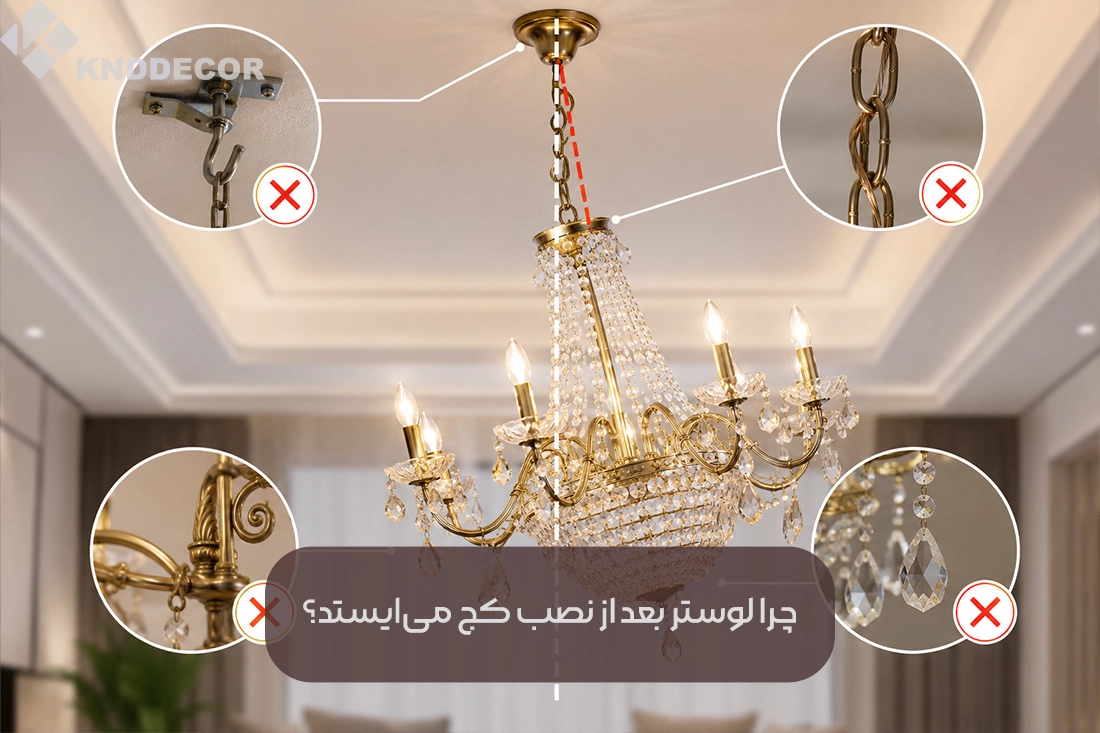
Why Does a Chandelier Hang Crooked After Installation? Causes and Solutions for Leveling a Chandelier
-
 نویسنده:
کارشناس فروش
- تاریخ انتشار:
- Reading time: 4 minutes

-
نویسنده:
کارشناس فروش
- تاریخ انتشار:
- Reading time: 4 minutes
Sometimes, after purchasing and installing a chandelier, everything seems correct at first glance; however, once the light is turned on or you step a few feet away, you notice that the body or the branches of the chandelier are not perfectly level. This issue is more noticeable in branched, multi-tier, and heavier chandelier models.
A tilted chandelier does not always mean the product itself is defective. In many cases, the problem arises from the installation method, ceiling connections, the chain, or even an improper weight distribution of the branches. Identifying the cause can prevent damage to the chandelier and the ceiling, and also improve the final appearance of the lighting.
First reason: Uneven installation surface
One of the simplest causes is the misalignment of the component to which the chandelier is attached. If the hook, base, or mounting bracket is not perfectly in place, the weight of the chandelier will not be distributed evenly.
This might not be very noticeable for a lightweight lamp, but in larger chandeliers, even a few millimeters of difference can cause the body to tilt out of its vertical position.
For this reason, it is best to inspect the ceiling connection point before installation and ensure that it is securely fastened.
The weight of the chandelier must be distributed evenly
Chandeliers that feature multiple branches, pendants, or decorative elements must have a balanced weight. If one part is heavier or the pieces are installed asymmetrically, the center of gravity of the chandelier shifts.
This issue is more significant in classic and crystal models. In such products, a large number of decorative pieces are placed in various sections, and even the slightest discrepancy in how they are installed can affect the final balance.
For example, when choosing a suitable crystal chandelier for your living room don’t just look at its appearance; the structure, how the branches are connected, and the overall weight are also very important.
Check the chain or connecting wire
In some pendant models, the chandelier is connected to the ceiling via a chain or a wire. If the chain is twisted at the top or if the loop is not properly seated in the hook, the chandelier may tilt slightly to one side.
Sometimes, the electrical wire inside the chain or at the connection point creates improper pressure. This happens especially when the wire is overstretched.
Therefore, after installation, it is best to inspect the connection path from top to bottom to ensure no part is under unnecessary tension.
Why do some chandeliers become crooked after a while?
A chandelier does not always tilt immediately after installation. Sometimes everything is perfectly level at first, but after some time, the shape of the chandelier changes due to loosening connections or the shifting of certain parts.
Building vibrations, constant opening and closing of doors, movement of decorative elements, and even small bumps during cleaning can affect the installation status over time.
For this reason, it is better not to apply pressure to the branches and pendants when cleaning the chandelier, and parts should be cleaned using only appropriate methods.
Common Mistake: Adjusting the chandelier by hand pressure
One thing that might come to mind is grabbing the body of the chandelier and bending it in the opposite direction. This method is not recommended for correcting the level.
A chandelier is a collection of parts connected to each other, and applying pressure to the body or branches can cause damage to the connection points, deformation of parts, or even breakage of decorative sections.
If the problem is at the installation point, the connection itself must be corrected, rather than temporarily changing the appearance of the chandelier by pressing on the body.
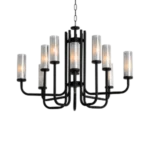
In branched chandeliers, all branches must be inspected
In branched models, the issue is slightly more complex. Sometimes the main body is perfectly straight, but one of the branches is positioned at a different angle, which makes the entire chandelier appear crooked.
In these cases, the connection point of each branch should be inspected. If the branch is adjustable, it can be gently repositioned into the correct place. However, if the connection is fixed or fragile, it is best to have it repaired by a professional.
Due to their wide form, branched models make even slight discrepancies between branches more noticeable.
Does the type of ceiling affect chandelier installation?
Yes. The material and structure of the ceiling play a crucial role in choosing the installation method.
Installing on concrete ceilings, false ceilings, drywall, or lightweight structures requires different methods. In any case, the connection point must be able to support the weight of the chandelier.
For a heavy chandelier, simply screwing a base into the visible part of the ceiling is not enough; the connection must be transferred to the appropriate part of the structure. This is highly important for safety and to prevent the fixture from tilting.
Pay attention to the weight of the chandelier before purchasing
One of the points that is often overlooked when purchasing is the product weight. Buyers tend to focus more on diameter, the number of bulbs, color, and appearance; whereas the weight of the chandelier can directly impact the installation method.
If a chandelier is being selected for a large space, it is better to examine its technical specifications in addition to its appearance. For example, luxury and highly detailed models may require sturdier connections compared to lightweight models.
If the chandelier becomes tilted, when should you seek professional help?
If a simple inspection reveals that the issue is caused by a single pendant or an adjustable part, it can be carefully corrected. However, in the following cases, it is better not to attempt to disassemble the connections yourself:
- The chandelier is very heavy.
- The ceiling mounting base has become loose.
- The electrical wire is under tension.
- The ceiling is a false ceiling or drywall (Knauf).
- Unusual sounds are heard from the connection point.
- The body becomes tilted again after every readjustment.
- There are heavy crystal or glass components on the chandelier.
In such circumstances, inspection by an installer or a specialist is a safer choice.
Don't just look at the appearance when buying a chandelier
A beautiful chandelier is a good choice when, in addition to its appearance, it is also compatible with the environment in terms of dimensions, weight, structure, and installation conditions.
If you are looking for a specific model for your living room, in addition to reviewing living room chandelier types, you should also consider the dimensions of your space and the exact installation location. This helps you choose a product that looks appropriate after installation and is technically compatible with your home’s conditions.
Summary
A chandelier hanging crookedly is usually an issue that needs investigation and should not be immediately attributed to low product quality. The connection point, installation method, chain, wiring, weight distribution, and the position of the arms can all affect the final level.
If the chandelier is slightly tilted after installation, the cause must first be identified, and you should avoid pushing the body to correct it. In cases where the problem relates to the ceiling connection or the high weight of the product, it is best to leave the task to a professional installer.
Ultimately, a proper installation is just as important as choosing the right model. Even the best chandelier cannot show its true splendor in the decor if it is installed incorrectly.