

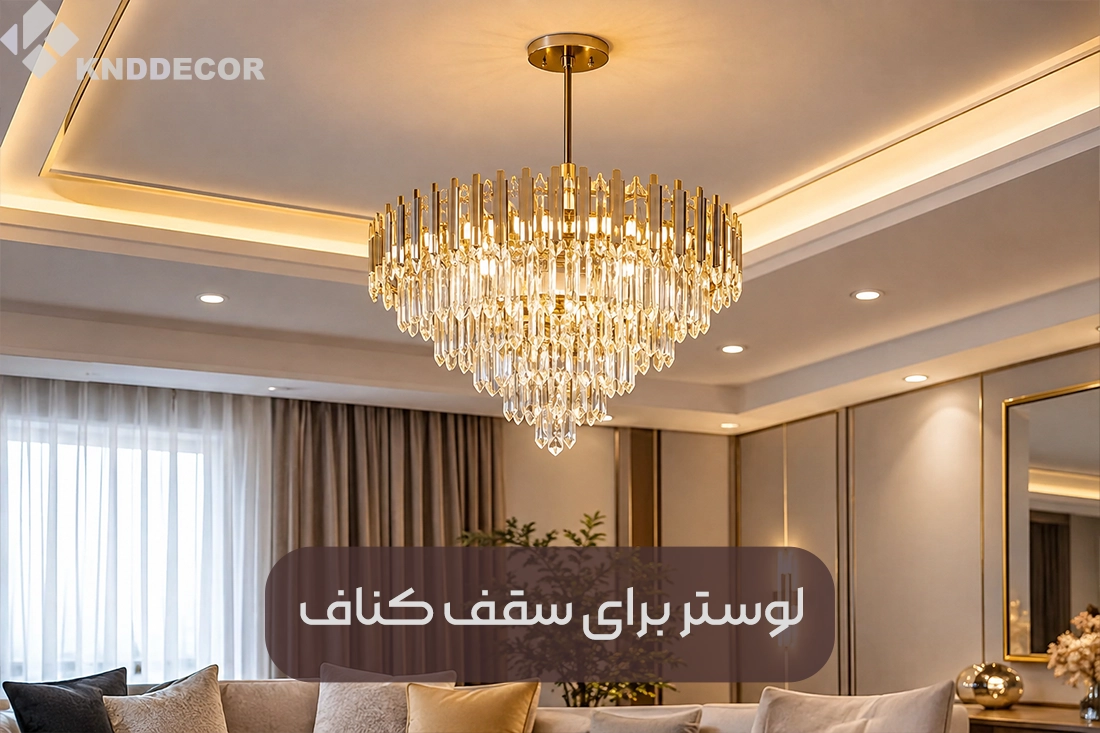
Chandeliers for Gypsum Board Ceilings; A Guide to Choosing Models, Sizes, and Proper Installation
-
 نویسنده:
کارشناس فروش
- تاریخ انتشار:
- Reading time: 6 minutes

-
نویسنده:
کارشناس فروش
- تاریخ انتشار:
- Reading time: 6 minutes
Knauf ceilings are one of the most popular methods for creating a unique design in home interiors. The combination of cove lighting, recessed lights, and a suitable chandelier can completely transform the appearance of a living room. However, choosing a chandelier for a Knauf ceiling is slightly different from standard ceilings; in addition to visual aesthetics, you must also consider ceiling dimensions, the location of the structural support, the weight of the chandelier, and the placement of the lights.
If you intend to choose a chandelier for a living room, sitting room, or even a dining room with a Knauf ceiling, it is best to consider several important points before purchasing.
Is it possible to install a chandelier on a Knauf ceiling?
Yes, but there is one important point: the weight of the chandelier should not rest solely on the Knauf board.
Knauf is essentially a lightweight covering used to shape the ceiling, and for installing heavy equipment, proper structural support must be present at the intended location. This is especially important for large, multi-arm, or heavier chandelier models.
For this reason, if the Knauf ceiling has not yet been installed, it is best to determine the chandelier’s installation point from the beginning. In this case, proper reinforcement can be implemented at the specific point, allowing the chandelier to be installed after completion without damaging the ceiling.
Which type of chandelier is more suitable for a Knauf ceiling?
No specific model can be introduced as the best chandelier for all gypsum board (Knauf) ceilings. The right choice depends on the decoration style, the size of the space, and the design of the ceiling itself.
For example, if the gypsum board has a simple design with straight lines and cove lighting, a modern chandelier can be a suitable choice. On the other hand, for living rooms with classic designs and decorative moldings, classic or crystal models create better harmony.
If you are still undecided between different models, viewing various types of chandeliers for different decorations can be a good starting point for comparing the shape, style, and dimensions of the models.
Modern Chandelier for Gypsum Board Ceilings
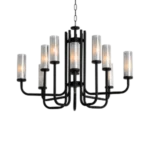
One of the combinations frequently seen in modern interior design is the use of a simple gypsum board ceiling alongside a modern chandelier.
In this type of decoration, it is usually better for the chandelier to have a distinct and relatively simple form. Models with geometric lines, ring shapes, or minimalist designs can create a more organized look when paired with ceiling cove lighting.
The important point is not to overcomplicate all the ceiling elements. If the gypsum board features multiple moldings, cove lighting, and recessed lights, a simple chandelier sometimes yields much better results than highly detailed models.
Classic Chandelier on Gypsum Board Ceiling
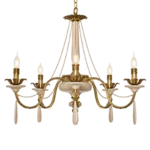
Using a classic chandelier on a drywall (Knauf) ceiling is also completely possible, provided that a balance is maintained between the ceiling decorations and the chandelier itself.
If the ceiling has many moldings and a very busy, detailed chandelier is chosen at the same time, the living area may appear overly heavy.
In such cases, it is better if one of these two elements plays the primary role. For example, if the chandelier is highly detailed, the drywall design can be simpler.
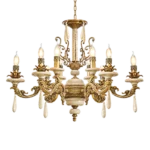
To see an example of a model with a stronger visual presence, the Valter chandelier can be reviewed for comparison of form and style.
What should be the size of the chandelier for a drywall ceiling?
One common mistake when buying a chandelier is focusing only on the square footage of the house. However, the dimensions of the central drywall section and the ceiling height are also very important.
Suppose your living room is 30 square meters, but the central drywall section has created a relatively small space for installing a chandelier. In this case, choosing an oversized model can disrupt the design balance.
Before purchasing, it is better to determine these measurements:
- Length and width of the living room
- Ceiling height
- Length and width of the central drywall section
- Distance from the installation point to the walls
- Placement of the coffee table or dining table
- Distance of the chandelier from other light sources
Once these measurements are determined, choosing the suitable chandelier for the living room will be much easier.
Large chandeliers for drywall ceilings; a choice for spacious areas
If you have a high ceiling and a large living room, using a small chandelier will usually make the center of the ceiling look empty and disproportionate.
In large spaces, you can opt for larger or multi-arm models. Of course, the size of the chandelier must be coordinated with the overall dimensions of the space and should not be so large that it obstructs walkways or visual sightlines.
In such spaces, ceiling height is also very important. If the ceiling is high, pendant models can better fill the empty volume between the ceiling and the furniture.
What chandelier should we buy for a low ceiling?
If the ceiling height is low or the drywall design has reduced the effective height, it is better to choose models that have a low profile.
Flush-mount chandeliers or models with a horizontal form are usually more logical options for such spaces.
Conversely, using a very long chandelier on a low ceiling can make the space look smaller and even create practical issues.
Therefore, when buying a chandelier, do not just look at its appearance; the product’s height is one of the most important specifications that must be measured before purchase.
Coordinating the chandelier with drywall cove lighting
One of the attractions of Knauf ceilings is the ability to simultaneously use cove lighting, recessed lights, and chandeliers.
In such cases, the chandelier does not necessarily have to provide all the room’s lighting. You can use cove lighting for background illumination and the chandelier for main lighting and to create a focal point.
For example, if the cove lighting is very intense, choosing a chandelier with very dim light might result in the chandelier not being very noticeable in the overall design.
On the other hand, if both the chandelier and the ceiling lights are very powerful, the environment may become overly bright and tiring.
Don't forget the light color temperature
Light color is another detail that can affect the final result.
In classic and warm spaces, warm light usually creates a more intimate feeling. In modern decorations, you can choose natural or warm light based on the color of the furniture, walls, and materials used.
It is better for the chandelier’s light color to be consistent with the cove lighting and recessed lights. A sharp difference between light source colors can make the ceiling design look inconsistent.
Is a crystal chandelier suitable for a Knauf ceiling?
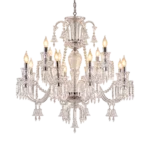
A crystal chandelier can look very striking on a Knauf ceiling, especially when the ceiling design is simple.
The light reflection from the crystals makes the chandelier the main focal point of the room. Therefore, if you decide to choose a crystal model, it is better that the other parts of the ceiling are not overly busy.
To compare a crystal model and check its suitability for such a space, you can also examine the Baccarat chandelier alongside other options.
Where should the chandelier be installed on a Knauf ceiling?
In most living rooms, the chandelier is placed at the visual center of the space; however, this rule does not always mean the geometric center of the ceiling.
If you have a specific dining table, furniture, or seating area in the living room, it might be better to determine the chandelier’s installation location based on the space’s usage.
For example, a chandelier above a dining table should ideally be aligned exactly with the center of the table, not necessarily with the center of the entire room.
In Knauf ceilings, it is also better for the chandelier’s installation location to be consistent with the ceiling moldings so that the product does not end up off the main design axis.
The most important point: the structural reinforcement of the installation site
If a heavy chandelier is to be installed on a drywall ceiling, the reinforcement is extremely important.
Directly installing a heavy chandelier onto drywall is not a professional or reliable method. The installation site must be inspected beforehand and, if necessary, connected to the main structure or appropriate reinforcement.
It is best not to leave this until the installation time. If the ceiling is still under construction, the best time to plan the installation site and implement reinforcement is during the ceiling construction phase.
Common mistakes in choosing a chandelier for drywall ceilings
A few mistakes can affect even a beautiful drywall design:
Choosing a chandelier without measuring
Before purchasing, the ceiling dimensions, central space, and room height must be determined.
Choosing an oversized chandelier
Bigger is not always better. The chandelier must be proportional to its surrounding space.
Ignoring the weight of the chandelier
For heavy models, the installation site and reinforcement must be professionally inspected.
Using too many decorative elements simultaneously
A busy drywall design paired with a highly detailed chandelier can cause visual clutter.
Inconsistent light colors
The chandelier light, cove lighting, and recessed lights should ideally be coordinated in terms of color temperature.
What should we check before buying a chandelier for a drywall ceiling?
To avoid having to replace or move the chandelier later, check these items before purchasing:
- Measure the ceiling height.
- Determine the dimensions of the central drywall section.
- Determine the exact installation location.
- Check the weight of the intended chandelier.
- Ask the installer about the ceiling reinforcement conditions.
- Consider the placement of recessed lights and cove lighting.
- Coordinate the chandelier’s light color with other light sources.
- Match the chandelier style with the overall home design.
- Verify the final product dimensions before purchasing.
Summary
Choosing a chandelier for gypsum board ceilings is not just a decorative choice. The chandelier model must be compatible with the ceiling structure in terms of size, height, weight, light type, and installation location.
If the gypsum board is plain, a statement chandelier can be used to create a focal point. If the ceiling is highly detailed, simpler models usually create a more balanced result.
On the other hand, when dealing with large and heavy chandeliers, the structural reinforcement issue should not be ignored. It is best to determine the installation point during the gypsum board installation process to ensure the product is securely attached.
Finally, to explore different models and choose the option that fits your space, you can browse various chandelier models and then make your final decision based on ceiling size, decoration style, and required lighting levels.